Zero-Day Exploits: Proactive Detection in US Digital Infrastructures

Proactive detection of zero-day exploits in US digital infrastructures involves integrating advanced threat intelligence, behavioural analytics, and AI-driven anomaly detection to significantly reduce initial breach success rates within a three-month timeframe.
In the complex landscape of modern cyber threats, the danger posed by zero-day exploit detection looms large over US digital infrastructures. These insidious vulnerabilities, unknown to vendors and security researchers, can allow attackers to bypass traditional defences with devastating speed. This article delves into practical solutions for proactively identifying and neutralising zero-day exploits, with the ambitious goal of mitigating 90% of initial breaches within a mere three months.
Understanding the Zero-Day Threat Landscape
Zero-day exploits represent a critical challenge in cybersecurity, as they target software vulnerabilities that are unknown to the developer or the public. This lack of prior knowledge means that traditional signature-based detection methods are often ineffective, leaving systems exposed until a patch is developed and deployed. The US digital infrastructure, encompassing critical sectors like energy, finance, and government, presents a particularly attractive target for adversaries seeking to exploit these weaknesses for espionage, sabotage, or financial gain.
The speed at which these exploits can be weaponised and deployed highlights the imperative for a proactive and adaptive defence strategy. Attackers are constantly searching for new vulnerabilities, and once found, they can be leveraged almost immediately. This dynamic requires a shift from reactive patching to predictive and behavioural threat detection.
The Evolving Nature of Exploits
The sophistication of zero-day exploits continues to grow, often incorporating advanced evasion techniques. Attackers frequently use polymorphic code, anti-analysis measures, and encrypted communications to hide their activities. This makes their identification even more challenging, demanding security solutions that can look beyond simple signatures.
- Polymorphic Code: Constantly changes its appearance to evade signature-based detection.
- Anti-Analysis Techniques: Designed to detect and thwart reverse engineering efforts.
- Encrypted Communications: Hides malicious traffic within legitimate-looking data streams.
- Supply Chain Attacks: Exploiting weaknesses in third-party software or hardware.
Confronting zero-day threats requires a comprehensive understanding of their underlying mechanisms and the diverse tactics employed by threat actors. This foundational knowledge is crucial for developing and implementing effective detection and mitigation strategies, moving beyond conventional security paradigms.
Advanced Threat Intelligence Integration
Integrating advanced threat intelligence is paramount for enhancing the proactive detection of zero-day exploits. This involves collecting, processing, and analysing vast amounts of data from various sources to identify emerging threats, attack patterns, and adversary behaviours. For US digital infrastructures, this means leveraging both governmental and private sector intelligence feeds to gain a holistic view of the threat landscape.
Effective threat intelligence moves beyond simply listing known indicators of compromise (IOCs). It focuses on understanding the tactics, techniques, and procedures (TTPs) used by advanced persistent threats (APTs). By understanding these TTPs, organisations can anticipate potential attack vectors and implement preventative measures even before a specific zero-day exploit is publicly known.
Leveraging Global and Local Intelligence
A multi-faceted approach to threat intelligence ensures broad coverage. This includes subscribing to global threat intelligence platforms, participating in industry-specific information sharing and analysis centres (ISACs), and collaborating with government agencies like CISA (Cybersecurity and Infrastructure Security Agency).
- Global Threat Feeds: Provide insights into worldwide cyber campaigns and emerging vulnerabilities.
- ISACs and ISAOs: Offer sector-specific threat information and collaborative defence strategies.
- Government Partnerships: Facilitate sharing of classified and sensitive threat data relevant to national security.
- Open-Source Intelligence (OSINT): Monitoring dark web forums and security research for early warnings.
By effectively integrating and acting upon advanced threat intelligence, organisations can improve their ability to predict and prepare for zero-day attacks, significantly reducing the window of opportunity for attackers and enhancing overall resilience.
Behavioural Analytics and Anomaly Detection
Given the stealthy nature of zero-day exploits, relying solely on signature-based detection is insufficient. Behavioural analytics and anomaly detection offer a powerful alternative by establishing a baseline of normal system and user behaviour, then flagging any deviations. This approach doesn’t require prior knowledge of an exploit; instead, it identifies suspicious activities that might indicate a novel attack.
For US digital infrastructures, this means continuously monitoring network traffic, endpoint activities, and user interactions. Machine learning algorithms can process this vast amount of data to discern subtle patterns that signify malicious intent. For example, an unusual outbound connection from a typically internal server or an atypical file access pattern by a user could indicate a compromised system.
Implementing AI-Driven Detection Systems
AI and machine learning are at the forefront of behavioural anomaly detection. These systems can learn from historical data, adapt to new behaviours, and identify sophisticated attack techniques that human analysts might miss. The goal is to detect the ‘unknown unknowns’ that characterise zero-day attacks.
- User and Entity Behaviour Analytics (UEBA): Identifies anomalous user activities, such as unusual login times or data access patterns.
- Network Traffic Analysis (NTA): Monitors network flows for deviations from established baselines, detecting command-and-control communications or data exfiltration.
- Endpoint Detection and Response (EDR): Provides real-time visibility into endpoint activities, identifying malicious processes or file modifications.
- Automated Alerting: Triggers immediate alerts for security teams upon detection of critical anomalies.
The successful deployment of behavioural analytics and anomaly detection systems can drastically improve the chances of catching zero-day exploits in their initial stages, thus preventing widespread damage and enabling rapid response.
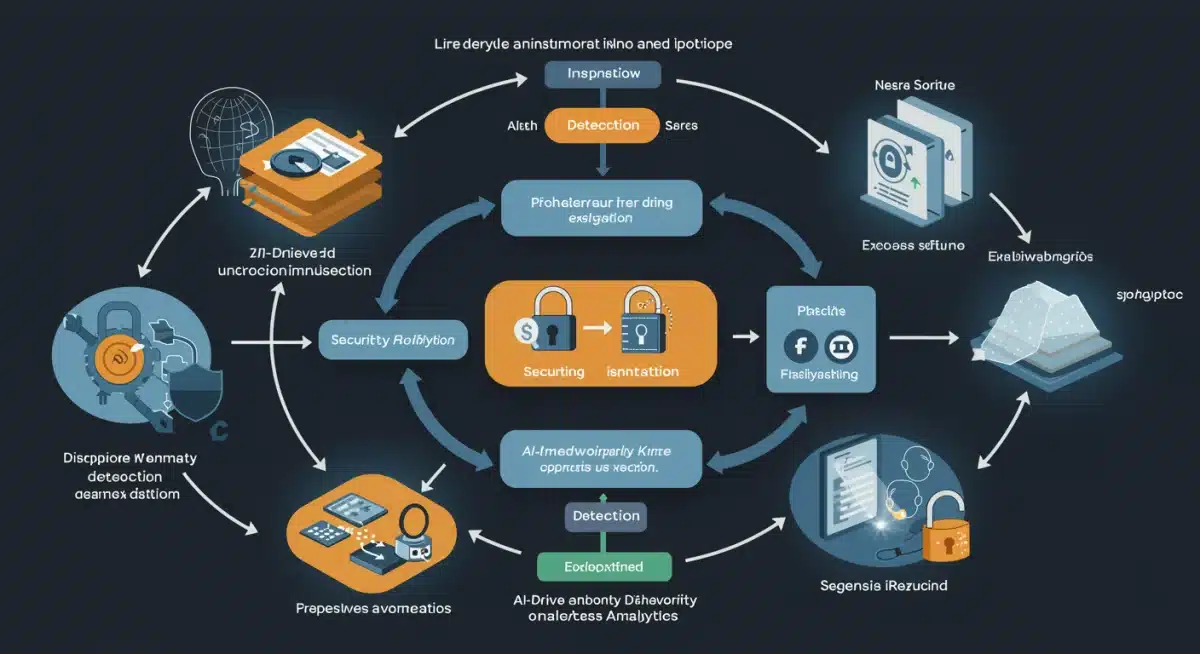
Endpoint Detection and Response (EDR) for Early Mitigation
Endpoint Detection and Response (EDR) solutions play a pivotal role in mitigating zero-day exploits by providing deep visibility into endpoint activities and enabling rapid response capabilities. While network-level detection is crucial, many zero-day attacks ultimately manifest on endpoints, making robust endpoint security indispensable for US digital infrastructures.
EDR systems continuously monitor and record all activities on endpoints, including process execution, file modifications, network connections, and user actions. This granular data allows security teams to detect even the most subtle indicators of compromise (IOCs) that might signify a zero-day attack in progress. Unlike traditional antivirus, EDR focuses on behavioural analysis and forensic capabilities, enabling the hunting of advanced threats.
Key EDR Capabilities for Zero-Day Defence
Effective EDR solutions go beyond simple alerting. They provide tools for investigation, containment, and remediation, significantly reducing the impact of an exploit. Their ability to rollback malicious changes or isolate compromised systems is critical during an active zero-day attack.
- Continuous Monitoring: Records all endpoint activities for forensic analysis.
- Threat Hunting: Allows security analysts to proactively search for signs of compromise.
- Automated Response: Can automatically isolate infected endpoints or terminate malicious processes.
- Forensic Capabilities: Gathers detailed evidence for post-incident analysis and understanding attack vectors.
By deploying advanced EDR solutions across critical US digital infrastructure, organisations can significantly enhance their ability to detect, respond to, and ultimately mitigate the impact of zero-day exploits, even those that bypass perimeter defences.
Proactive Vulnerability Management and Patching
Even with advanced detection methods, a robust proactive vulnerability management and patching strategy remains a cornerstone of defence against zero-day exploits. While zero-days, by definition, are unknown, many attacks exploit vulnerabilities that have been known but unpatched for extended periods. A rigorous approach to identifying and remediating known vulnerabilities reduces the overall attack surface, making it harder for attackers to find and exploit zero-days.
For US digital infrastructures, this means implementing a continuous process of vulnerability scanning, penetration testing, and timely patch deployment across all systems and applications. Prioritisation of patching should be based on risk assessments, focusing on critical systems and those exposed to the internet. This proactive stance significantly reduces the number of potential entry points for attackers.
Best Practices for Vulnerability Management
Effective vulnerability management extends beyond simply running scans. It involves a strategic approach to understanding, prioritising, and remediating risks. This includes regular audits and adherence to security best practices.
- Regular Vulnerability Scans: Automated scanning of networks, applications, and systems.
- Penetration Testing: Simulating real-world attacks to identify exploitable weaknesses.
- Strict Patch Management: Timely application of security updates and patches.
- Secure Configuration Management: Ensuring all systems are configured according to security best practices.
By diligently managing and reducing known vulnerabilities, organisations within US digital infrastructures can create a more resilient environment, forcing attackers to expend greater effort to find and exploit less common or truly zero-day vulnerabilities.
Building Cyber Resilience and Incident Response
Beyond detection and prevention, building robust cyber resilience and a highly effective incident response plan is crucial for mitigating the impact of zero-day exploits. No defence is impenetrable, and organisations must be prepared for the inevitable breach. For US digital infrastructures, this means having the capabilities to quickly contain, eradicate, and recover from an attack, minimising downtime and data loss.
An effective incident response plan for zero-day exploits must be dynamic and adaptable. It should include clear roles and responsibilities, established communication channels, and predefined procedures for various attack scenarios. Regular drills and simulations are essential to test the plan’s effectiveness and ensure that teams are well-prepared to act decisively under pressure.
Key Components of a Resilient Incident Response
A comprehensive incident response framework considers all phases of an attack, from initial detection to post-incident review. This holistic approach ensures that lessons learned are integrated back into the security posture.
- Preparation: Establishing policies, procedures, and tools before an incident occurs.
- Identification: Detecting and confirming the occurrence of a security incident.
- Containment: Limiting the scope and impact of the incident.
- Eradication: Removing the threat from affected systems.
- Recovery: Restoring systems and data to normal operations.
- Post-Incident Review: Analysing the incident to improve future responses.
By prioritising cyber resilience and developing a mature incident response capability, US digital infrastructures can significantly reduce the duration and severity of zero-day exploit impacts, moving towards the goal of mitigating 90% of initial breaches within three months.
| Key Aspect | Brief Description |
|---|---|
| Proactive Detection | Utilising advanced techniques to identify unknown vulnerabilities before exploitation. |
| Threat Intelligence | Integrating global and local feeds for early warning and TTP analysis. |
| Behavioural Analytics | AI-driven monitoring for anomalous system and user behaviour. |
| Incident Response | Rapid containment, eradication, and recovery strategies for breaches. |
Frequently Asked Questions About Zero-Day Exploit Detection
A zero-day exploit refers to a cyber attack that targets a software vulnerability unknown to the software vendor or the public. Attackers exploit this ‘zero-day’ knowledge gap, meaning there’s no patch available at the time of the attack, making detection and prevention particularly challenging for traditional security measures.
Zero-days are highly dangerous because they bypass established defences, offering attackers a direct route into critical systems without prior detection. For US digital infrastructures, this poses a significant risk to national security, economic stability, and public services, as these systems are often interconnected and vital.
Behavioural analytics establishes a baseline of normal system and user activity. By using AI and machine learning, it can identify deviations from this norm, such as unusual file access or network communication patterns. These anomalies can indicate an ongoing zero-day attack, even without a known signature.
Threat intelligence provides crucial insights into emerging threats, attacker TTPs, and potential vulnerabilities. By aggregating data from various sources, organisations can anticipate attack vectors, understand adversary motivations, and implement preventative controls before a specific zero-day exploit is widely known or deployed against their systems.
Achieving a 90% mitigation rate for initial breaches within three months is an ambitious but attainable goal. It requires a significant investment in advanced security technologies, skilled personnel, robust processes, and a culture of continuous improvement, particularly in proactive detection and rapid incident response capabilities across US digital infrastructures.
Conclusion
The challenge of zero-day exploits in US digital infrastructures demands a strategic, multi-layered approach to cybersecurity. By embracing advanced threat intelligence, leveraging behavioural analytics and AI-driven detection, implementing robust EDR solutions, and maintaining rigorous vulnerability management, organisations can move towards a significantly more proactive defence posture. The ambitious goal of mitigating 90% of initial breaches within three months is achievable through continuous adaptation, investment in cutting-edge technologies, and fostering a culture of cyber resilience. Protecting these critical assets is not merely a technical task but a continuous commitment to national security and economic stability.