IoT Threat Detection: Safeguarding US Smart Devices from Emerging Attacks in 2026

The proliferation of Internet of Things (IoT) devices has transformed our lives, offering unprecedented convenience, efficiency, and connectivity. From smart homes and connected cars to industrial sensors and medical wearables, IoT is deeply embedded in the fabric of modern society. However, this interconnectedness also presents a vast and ever-expanding attack surface for cybercriminals. As we look towards 2026, the urgency for robust IoT threat detection mechanisms in the United States is paramount. This article provides an insider’s look into the evolving landscape of IoT security, detailing the emerging threats and the innovative strategies being deployed to safeguard US smart devices.
The Escalating Threat Landscape for IoT in 2026
The year 2026 is poised to be a pivotal moment for IoT security. The sheer volume of devices, coupled with increasing sophistication of cyberattacks, demands a proactive and intelligent approach to IoT threat detection. Traditional security measures, often designed for conventional IT environments, are frequently inadequate for the unique challenges posed by IoT. These challenges include diverse device types, limited processing power and memory on many endpoints, fragmented vendor ecosystems, and a lack of standardized security protocols.
Emerging Attack Vectors and Tactics
By 2026, we anticipate several key shifts in attack vectors targeting IoT devices:
- Advanced Persistent Threats (APTs): Nation-state actors and sophisticated criminal organizations will increasingly target IoT infrastructure to gain long-term access for espionage, sabotage, or data theft. These attacks are characterized by their stealth, persistence, and ability to evade traditional defenses.
- Supply Chain Attacks: Vulnerabilities introduced during the manufacturing or distribution of IoT components will become a major concern. Attackers can inject malicious code or hardware at various stages, compromising devices before they even reach the end-user.
- AI-Powered Malware: The rise of artificial intelligence will not be limited to defensive strategies. Attackers will leverage AI and machine learning to create more adaptive, evasive, and autonomous malware capable of learning device behaviors and circumventing security controls.
- Edge-Based Attacks: As more processing moves to the ‘edge’ of the network to reduce latency and bandwidth usage, these edge devices will become prime targets. Compromising an edge device can provide a gateway to broader networks or enable localized attacks.
- Physical Tampering and Side-Channel Attacks: While often overlooked in software-centric security, physical access to IoT devices can expose vulnerabilities. Side-channel attacks, which exploit information leaked from the physical implementation of a cryptographic system (e.g., power consumption, electromagnetic emanations), will also see increased sophistication.
- Ransomware on Critical Infrastructure IoT: The impact of ransomware on critical infrastructure (e.g., energy grids, water treatment plants) connected via IoT devices could be catastrophic. Attackers will increasingly target these systems for maximum leverage.
Why Traditional Security Falls Short for IoT
Many IoT devices are designed for specific functions with cost and power efficiency in mind, leading to several security shortcomings:
- Limited Resources: Many IoT endpoints lack the computational power or memory to run complex security software or robust encryption algorithms.
- Default Credentials and Weak Passwords: A persistent problem, many devices ship with easily guessable default credentials, making them easy targets for brute-force attacks.
- Lack of Updates and Patching: A significant portion of IoT devices receive infrequent or no security updates, leaving known vulnerabilities unaddressed for extended periods.
- Fragmented Ecosystem: The vast number of manufacturers, operating systems, and communication protocols makes it challenging to implement a unified security strategy.
- Lack of Visibility: Organizations often have poor visibility into the IoT devices connected to their networks, making it difficult to detect and respond to threats.
The Core Pillars of Advanced IoT Threat Detection in 2026
To effectively combat the evolving threat landscape, IoT threat detection in 2026 will rely on a multi-layered, intelligent, and adaptive approach. Here are the core pillars:
1. AI and Machine Learning for Anomaly Detection
Artificial Intelligence (AI) and Machine Learning (ML) are not just buzzwords; they are becoming indispensable for effective IoT threat detection. Traditional signature-based detection struggles against zero-day exploits and polymorphic malware. AI/ML, however, can learn normal behavior patterns of individual IoT devices and entire networks, enabling the detection of subtle deviations that indicate malicious activity.
- Behavioral Analytics: ML algorithms can profile the typical communication patterns, data flows, and operational states of each IoT device. Any significant departure from this baseline – such as unusual data uploads, connections to unknown IP addresses, or unexpected command executions – can trigger an alert.
- Predictive Analytics: By analyzing historical data and current threat intelligence, AI can identify patterns that precede an attack, allowing for preemptive action. For example, a sudden increase in scanning attempts from a particular region might predict an impending distributed denial-of-service (DDoS) attack.
- Automated Threat Hunting: AI-powered systems can continuously scan networks for anomalies and potential threats, reducing the burden on human analysts and improving detection speed.
- Deep Learning for Malware Analysis: Deep learning models can analyze the characteristics of new or unknown malware variants, identifying malicious intent even without prior signatures. This is crucial for combating AI-generated malware.
2. Edge-Based Security and Distributed Intelligence
Given the resource constraints of many IoT devices and the need for real-time response, pushing security intelligence closer to the edge of the network is critical. Edge-based security involves deploying lightweight security agents or micro-firewalls directly on or near IoT devices.
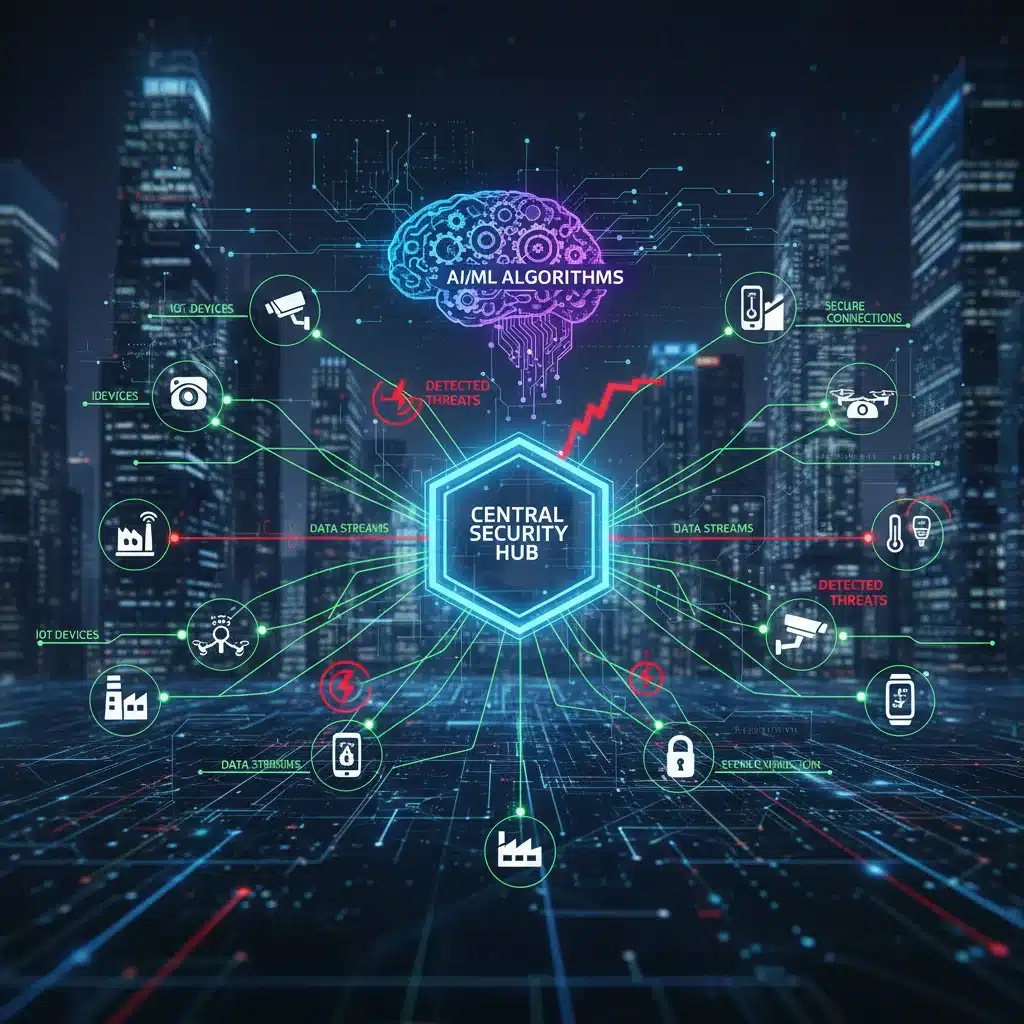
- Local Anomaly Detection: Edge devices can perform initial anomaly detection locally, reducing the need to send all data to a central cloud for analysis, which improves latency and privacy.
- Decentralized Threat Intelligence: A distributed ledger or blockchain approach can be used to share threat intelligence among trusted IoT devices and gateways, allowing for faster collective response to newly identified threats.
- Micro-segmentation: Isolating IoT devices or groups of devices into micro-segments within the network limits the lateral movement of attackers if one device is compromised.
- Hardware-Root-of-Trust (HRoT): Embedding security directly into the hardware of IoT devices provides a foundational layer of trust, ensuring device integrity from boot-up to operation.
3. Zero Trust Architectures for IoT
The principle of ‘never trust, always verify’ is more relevant than ever for IoT. A Zero Trust architecture assumes that no user, device, or application, whether inside or outside the network perimeter, should be trusted by default. Every connection and request must be authenticated and authorized.
- Identity and Access Management (IAM) for Devices: Each IoT device must have a unique, strong identity, and its access to network resources should be strictly controlled based on its role and context.
- Continuous Verification: Authentication and authorization are not one-time events. Devices are continuously re-verified based on their behavior, location, and the sensitivity of the data they are accessing.
- Least Privilege Access: IoT devices should only be granted the minimum necessary permissions to perform their intended functions, limiting the potential damage if compromised.
4. Threat Intelligence and Collaborative Defense
Staying ahead of emerging threats requires access to timely and actionable threat intelligence. Collaboration across industries, government agencies, and research institutions is vital for effective IoT threat detection.
- Global Threat Feeds: Integrating data from various sources – including dark web monitoring, vulnerability databases, and incident reports – provides a comprehensive view of the threat landscape.
- Information Sharing and Analysis Centers (ISACs): Sector-specific ISACs play a crucial role in sharing threat information and best practices among organizations within critical infrastructure sectors.
- Automated Response Playbooks: Pre-defined automated responses, triggered by specific threat intelligence indicators, can significantly reduce the time to mitigate an attack.
Implementing Robust IoT Threat Detection: A Roadmap for US Organizations
For organizations operating in the US, implementing advanced IoT threat detection requires a strategic and holistic approach. Here’s a roadmap:
Phase 1: Discovery and Assessment
- Comprehensive Device Inventory: Gain complete visibility into all IoT devices connected to your network. This includes understanding device type, manufacturer, firmware version, and communication protocols.
- Risk Assessment: Evaluate the potential impact of a compromise for each device category. Prioritize security efforts based on the criticality of the devices and the data they handle.
- Vulnerability Scanning: Regularly scan IoT devices for known vulnerabilities and misconfigurations.
Phase 2: Architectural Design and Implementation
- Network Segmentation: Isolate IoT devices on dedicated network segments, separate from corporate IT networks. Use micro-segmentation where possible.
- Implement Zero Trust Principles: Establish strong identity and access management for all IoT devices and enforce least privilege.
- Deploy AI/ML-Powered Detection: Integrate behavioral analytics and anomaly detection solutions that are specifically designed for IoT environments.
- Secure Communication: Mandate strong encryption for all data transmitted to and from IoT devices. Implement secure boot and firmware integrity checks.
- Hardware Security Modules (HSMs): Utilize HSMs for secure key storage and cryptographic operations on critical IoT devices.
Phase 3: Continuous Monitoring and Response
- 24/7 Monitoring: Implement continuous monitoring of IoT network traffic and device behavior.
- Automated Alerting and Incident Response: Develop clear incident response plans for IoT security incidents, with automated alerts and pre-defined playbooks for common threats.
- Regular Patching and Updates: Establish a robust process for applying security patches and firmware updates to IoT devices. This often requires close collaboration with vendors.
- Threat Hunting: Proactively search for threats that may have bypassed automated defenses.
- Security Awareness Training: Educate employees about the risks associated with IoT devices and best security practices.
Regulatory Landscape and Compliance in the US
The US regulatory landscape for IoT security is evolving. While a comprehensive federal framework is still under development, several initiatives and regulations are pushing for stronger security:

- NIST Cybersecurity Framework: The National Institute of Standards and Technology (NIST) provides voluntary guidelines and best practices that are widely adopted for improving cybersecurity, including for IoT.
- IoT Cybersecurity Improvement Act of 2020: This act mandates that federal agencies only procure IoT devices that meet minimum security requirements, including vulnerability disclosure policies and secure development practices. This will likely influence the broader market.
- State-Level Regulations: States like California have enacted specific IoT security laws (e.g., SB-327), requiring reasonable security features for connected devices. More states are expected to follow suit.
- Sector-Specific Regulations: Industries like healthcare (HIPAA), finance (GLBA), and critical infrastructure (NIST frameworks, CISA directives) have specific compliance requirements that extend to IoT devices handling sensitive data or controlling critical operations.
Adhering to these regulations is not just about compliance; it’s about building a foundational level of trust and security for IoT deployments across the US. Ignoring these can lead to significant penalties, reputational damage, and operational disruptions.
The Future of IoT Threat Detection: Beyond 2026
Looking beyond 2026, the evolution of IoT threat detection will be shaped by several emerging technologies and trends:
- Quantum-Resistant Cryptography: As quantum computing advances, current encryption methods could become vulnerable. Research and development into quantum-resistant algorithms will be crucial for long-term IoT security.
- Digital Twins for Security: Creating digital replicas of physical IoT systems can allow for simulated attack scenarios and real-time vulnerability testing without impacting operational systems.
- Self-Healing Networks: Future IoT networks will incorporate more autonomous capabilities to detect, isolate, and recover from cyberattacks with minimal human intervention.
- Explainable AI (XAI) in Security: As AI becomes more central to threat detection, XAI will be critical for understanding why a particular alert was triggered, building trust, and improving the effectiveness of human analysts.
- Biometric Authentication for IoT: Advanced biometric methods could enhance device and user authentication in highly sensitive IoT environments.
Conclusion: A Secure Future for US Smart Devices
The journey towards a fully secure IoT ecosystem is ongoing and complex. However, with the rapid advancements in AI, machine learning, edge computing, and zero-trust principles, the tools and strategies for robust IoT threat detection are becoming increasingly sophisticated. For the United States, safeguarding its vast and growing network of smart devices by 2026 is not merely a technical challenge but a national security imperative.
Organizations must adopt a proactive, adaptive, and collaborative approach, continuously investing in cutting-edge security solutions and fostering a culture of cybersecurity awareness. By embracing these advanced strategies, we can ensure that the promise of a connected future is realized with the highest levels of security and resilience, protecting individuals, businesses, and critical infrastructure from the ever-present and evolving threats of the cyber world.
The time to act is now. The security posture we establish for our IoT devices today will determine the resilience of our digital infrastructure tomorrow.