Optimising SOC Performance: Reducing False Positives in Threat Detection by 20% by Mid-2026 (FINANCIAL IMPACT)

Optimising SOC Performance: Reducing False Positives in Threat Detection by 20% by Mid-2026 (FINANCIAL IMPACT)
In the evolving landscape of cyber threats, Security Operations Centres (SOCs) are the frontline defenders for organisations worldwide. Their primary mission is to detect, analyse, and respond to cyber incidents. However, a pervasive challenge that plagues many SOCs is the sheer volume of alerts, a significant portion of which turn out to be false positives. These false positives not only create alert fatigue among analysts but also consume valuable resources, leading to increased operational costs and a potential delay in identifying genuine threats. This article delves into strategic approaches for optimising SOC performance by targeting a SOC false positive reduction of 20% by mid-2026, outlining the methodologies, technologies, and the significant financial impact such an improvement can bring.
The financial implications of high false positive rates are often underestimated. Each false positive requires an analyst’s time for investigation, triage, and eventual dismissal. This time, when multiplied across hundreds or thousands of such alerts daily, translates into substantial operational expenditure. Furthermore, the constant bombardment of irrelevant alerts can lead to burnout, higher staff turnover, and a reduced capacity to focus on critical incidents. By achieving a SOC false positive reduction target, organisations can free up analyst time, reallocate resources more effectively, and ultimately strengthen their overall security posture while realising tangible financial benefits.
Understanding the Root Causes of False Positives in SOC Operations
Before embarking on a journey to achieve a significant SOC false positive reduction, it is crucial to understand why they occur. False positives are not merely an inconvenience; they are symptoms of underlying issues within the security ecosystem. One of the most common causes is improperly configured security tools. Signature-based detection systems, for instance, often rely on broad rules that can inadvertently flag legitimate activities as malicious. Poorly tuned SIEM (Security Information and Event Management) rules, lacking context or specific thresholds, are also major contributors.
Another significant factor is the lack of contextual information. An alert indicating a login from an unusual geographical location might be a false positive if the user is legitimately travelling. Without integrating identity and access management (IAM) data, travel schedules, or HR information, the SOC analyst has to manually investigate, wasting precious time. Similarly, alerts generated by endpoint detection and response (EDR) solutions can be overly aggressive, flagging legitimate system processes or software updates as suspicious without proper baselining or whitelisting.
The sheer volume and velocity of data ingested by SOC tools also play a role. As organisations generate more logs and telemetry, the probability of generating noise increases. Without intelligent filtering and correlation capabilities, this data deluge can overwhelm analysts. Furthermore, the complexity of modern IT environments, with hybrid clouds, remote workforces, and diverse application stacks, makes it challenging to establish accurate baselines of normal behaviour, leading to more frequent deviations being flagged as potential threats. Addressing these root causes systematically is the cornerstone of any effective SOC false positive reduction strategy.
Strategic Pillars for Achieving 20% False Positive Reduction
To achieve a 20% SOC false positive reduction by mid-2026, a multi-faceted approach is required, focusing on process, technology, and people. These strategic pillars work in concert to build a more efficient and effective SOC.
1. Enhancing Rule Optimisation and Tuning
The foundation of reducing false positives lies in the intelligent tuning of detection rules within your SIEM, EDR, and other security tools. This isn’t a one-time activity but an ongoing process. Start by reviewing existing rules and identifying those that frequently trigger false positives. For each identified rule, analyse the context in which it fires. Can thresholds be adjusted? Can additional exclusions be added without compromising detection capabilities? For example, if a rule flags unusual administrative activity, can it be refined to only trigger if that activity occurs outside of business hours or from an unapproved IP range?
Leverage threat intelligence to enrich your rules. By integrating up-to-date indicators of compromise (IOCs) and threat actor tactics, techniques, and procedures (TTPs), rules can become more precise. This ensures that your detection mechanisms are focused on actual threats rather than generic suspicious behaviours. Implementing a rigorous change management process for rule modifications is also vital to prevent unintended consequences and ensure continuous improvement in SOC false positive reduction efforts.
2. Leveraging Advanced Analytics and Machine Learning
Traditional signature-based detection has its limitations. Advanced analytics and machine learning (ML) offer powerful capabilities for identifying anomalies and reducing false positives. User and Entity Behaviour Analytics (UEBA) tools, for instance, can establish baselines of normal behaviour for users and entities within your network. When deviations occur, UEBA can flag them with higher confidence, significantly reducing the noise generated by legitimate but unusual activities.
Machine learning algorithms can be trained on historical data to distinguish between genuine threats and benign events. By learning from past investigations, these models can automatically suppress alerts that are highly likely to be false positives, allowing analysts to focus on more critical incidents. Implementing ML-driven alert correlation can also group related alerts, providing a more holistic view of potential incidents and helping to filter out individual noisy alerts. This technological advancement is key to achieving a substantial SOC false positive reduction.
3. Integrating Contextual Data Sources
As previously mentioned, a lack of context is a major driver of false positives. Integrating various data sources into your SIEM and incident response platforms can provide analysts with the necessary context to quickly determine the legitimacy of an alert. This includes:
- Identity and Access Management (IAM) data: Knowing who a user is, their typical access patterns, and their current location.
- Asset Management data: Understanding the criticality of an asset, its normal operating hours, and its software configuration.
- Vulnerability Management data: Knowing if a detected activity is exploiting a known vulnerability on a specific system.
- HR data: Information about employee travel, leave, or role changes that might explain unusual network activity.
- Business Process Information: Understanding scheduled maintenance windows or legitimate mass data transfers.
By enriching alerts with this contextual information, analysts can make faster, more accurate decisions, thereby contributing significantly to SOC false positive reduction. Automation can be used to pull this contextual data into the alert investigation process, streamlining workflows.
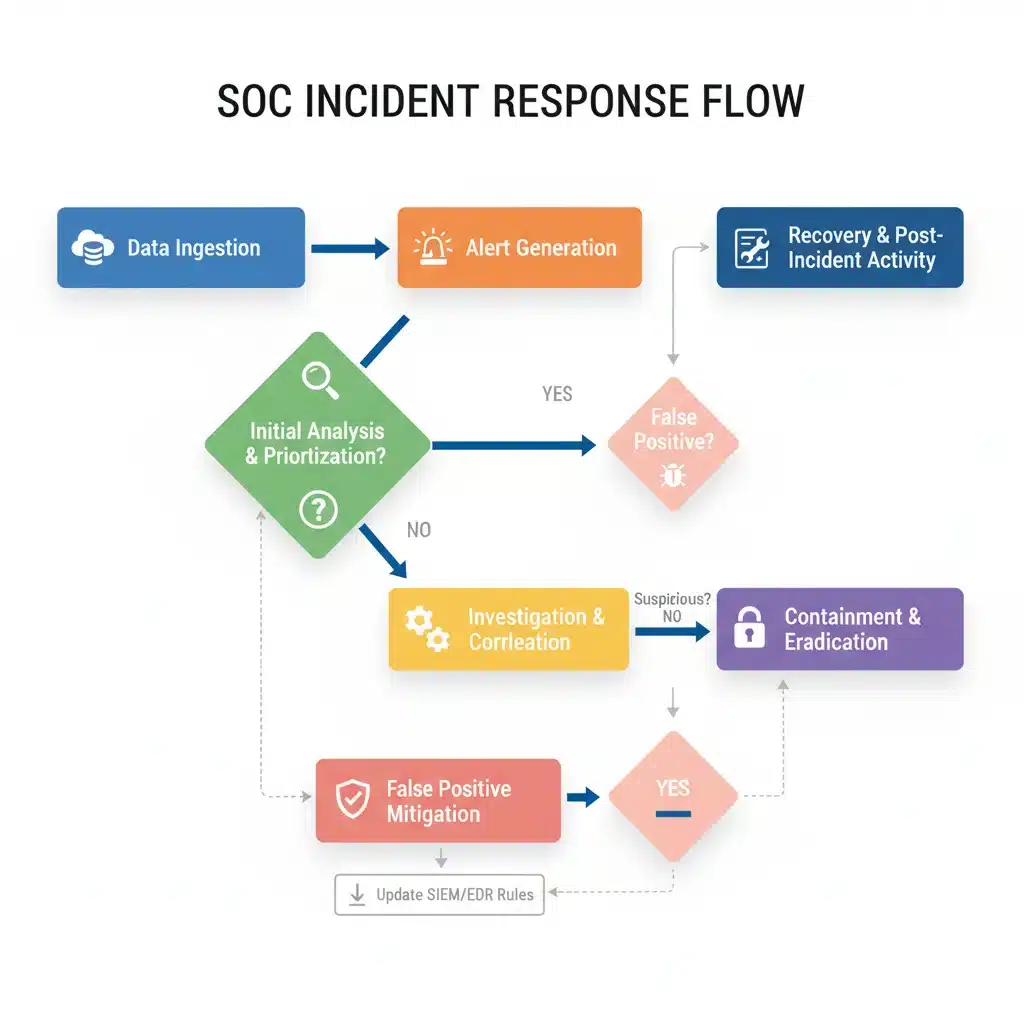
4. Implementing Security Orchestration, Automation, and Response (SOAR)
SOAR platforms are instrumental in automating repetitive tasks and orchestrating complex incident response workflows. For false positive reduction, SOAR can be used to automate the initial triage and enrichment of alerts. For example, a SOAR playbook could automatically query multiple external and internal data sources (threat intelligence feeds, asset databases, IAM systems) upon an alert trigger. Based on the gathered context, the playbook can then apply predefined logic to suppress known false positives or escalate genuine threats to an analyst with enriched information.
This automation not only speeds up the investigation process but also reduces human error and frees up analyst time to focus on more intricate threats. By automating the initial stages of alert validation, SOAR significantly contributes to achieving the target SOC false positive reduction.
5. Continuous Training and Feedback Loops
Even with advanced tools, the human element remains critical. Regular training for SOC analysts on new threat vectors, tool functionalities, and efficient investigation techniques is paramount. Furthermore, establishing robust feedback loops is essential. When an analyst identifies a false positive, that information should be fed back into the system to refine rules, improve AI models, and update baselines. This iterative process of learning and adaptation ensures continuous improvement in SOC false positive reduction.
Encourage analysts to document their investigations thoroughly, especially for false positives. This documentation serves as valuable training data for machine learning models and helps in identifying patterns that lead to recurring false alarms. Regular debriefs and knowledge sharing sessions within the SOC team can also highlight common false positive scenarios and best practices for their mitigation.
Measuring Success: Quantifying the 20% Reduction and Financial Impact
Achieving a 20% SOC false positive reduction is a measurable goal. To track progress and demonstrate financial impact, organisations need to establish clear metrics and baselines. Key performance indicators (KPIs) should include:
- False Positive Rate (FPR): The percentage of alerts that are deemed non-malicious after investigation.
- Mean Time to Resolve (MTTR) False Positives: The average time taken to investigate and close a false positive alert.
- Analyst Time Saved: Quantifying the hours saved due to reduced false positives and automation.
- Operational Cost Reduction: Directly linking time saved to salary costs and other operational expenses.
To calculate the financial impact, consider the average cost per alert investigation. This includes analyst salary, tool licensing costs associated with processing unnecessary data, and the opportunity cost of analysts not focusing on real threats. For example, if an average false positive investigation takes 15 minutes and an analyst’s fully loaded cost is £50 per hour, each false positive costs £12.50. Reducing 1,000 false positives per day by 20% (200 false positives) would save £2,500 daily, equating to approximately £912,500 annually. This direct financial saving highlights the immense value of a successful SOC false positive reduction initiative.
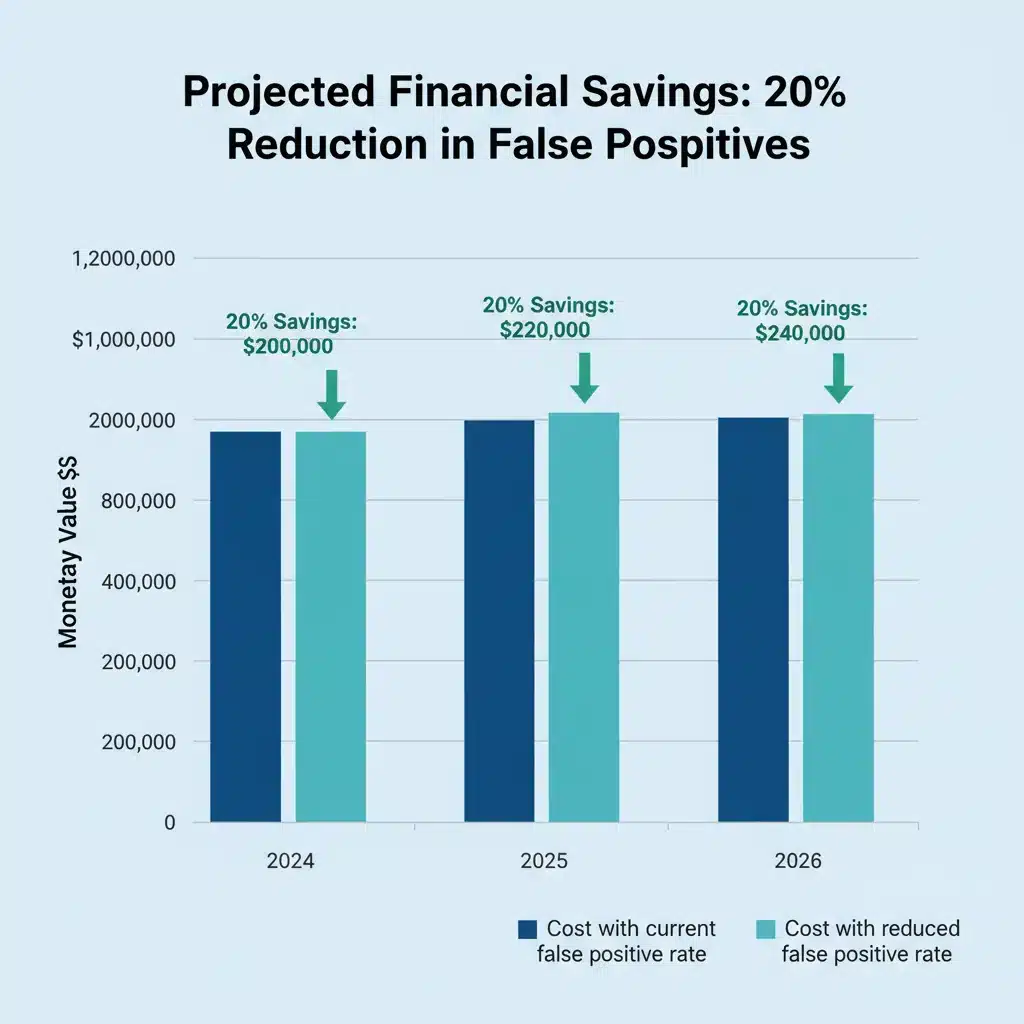
Furthermore, the financial impact extends beyond direct savings. A more efficient SOC is a more effective SOC. By reducing the noise, genuine threats are identified and addressed more quickly, reducing the likelihood of successful breaches and their associated costs (data loss, reputational damage, regulatory fines). This improved security posture offers significant indirect financial benefits that are harder to quantify but equally important.
Challenges and Mitigation Strategies
While the benefits of SOC false positive reduction are clear, the path to achieving it is not without challenges. Resistance to change from analysts accustomed to existing workflows, the complexity of integrating disparate data sources, and the initial investment in new technologies (like SOAR or UEBA) can be hurdles.
To mitigate these challenges, start with a pilot program. Implement changes incrementally, focusing on the most common or impactful false positive types first. Involve SOC analysts in the process from the outset, seeking their input and demonstrating how these changes will improve their daily work and reduce their workload. Provide comprehensive training and support for new tools and processes. Clearly communicate the financial and operational benefits to secure executive buy-in and continued investment.
Data quality is another critical aspect. Inaccurate or incomplete data can undermine even the most sophisticated analytics. Establish data governance policies to ensure the integrity and completeness of logs and other contextual information. Regularly review and cleanse data sources to maintain high-quality input for your detection systems, further aiding in SOC false positive reduction.
The Future of SOC Optimisation: Beyond 20% Reduction
Achieving a 20% SOC false positive reduction by mid-2026 is an ambitious yet attainable goal. However, the journey towards an optimised SOC is continuous. As threat actors evolve their techniques, so too must our detection and response capabilities. Future efforts will likely focus on even greater automation, leveraging advanced AI for predictive analytics, and integrating security into every stage of the software development lifecycle (DevSecOps) to prevent vulnerabilities from becoming threats.
The concept of ‘self-healing’ security, where systems can automatically remediate certain types of incidents without human intervention, is also gaining traction. This would further minimise the impact of both true and false positives, allowing SOC analysts to focus on truly novel and sophisticated attacks. The ultimate goal is to build a resilient, adaptive, and highly efficient SOC that can protect organisations effectively in an increasingly hostile cyber landscape.
Investing in continuous improvement, embracing new technologies, and fostering a culture of learning and adaptation within the SOC team are crucial for sustained success. The financial benefits reaped from a reduced false positive rate will not only justify these investments but also enable further enhancements, creating a virtuous cycle of security improvement and cost efficiency. The journey towards an optimised SOC, marked by a significant SOC false positive reduction, is an investment in the organisation’s future security and financial health.
Conclusion
The challenge of false positives in Security Operations Centres is a significant drain on resources and a hindrance to effective threat detection. By strategically implementing rule optimisation, leveraging advanced analytics and machine learning, integrating contextual data, deploying SOAR platforms, and fostering continuous training and feedback, organisations can realistically target and achieve a 20% SOC false positive reduction by mid-2026.
The financial impact of such a reduction is substantial, translating into direct cost savings from reduced analyst workload and indirect benefits from an improved security posture. While challenges exist, a phased approach, strong leadership, and continuous engagement with the SOC team can overcome them. The future of cybersecurity demands smarter, more efficient SOCs. By focusing on reducing false positives, organisations are not just streamlining operations; they are building a more robust and financially responsible defence against the ever-present cyber threat.
Embracing these strategies will not only enhance the effectiveness of your SOC but also provide a clear return on investment, solidifying the importance of proactive cybersecurity measures within the broader business strategy. The time to act on SOC false positive reduction is now, paving the way for a more secure and economically sound future.