Ransomware Detection: Proactive Measures for US Businesses in 2025

Implementing advanced ransomware detection proactive measures is paramount for US businesses to effectively mitigate and neutralise cyber threats within a critical three-month timeframe in 2025, significantly enhancing their digital resilience.
In an increasingly interconnected digital landscape, the threat of ransomware looms large over US businesses. Proactive ransomware detection proactive measures are no longer optional but a fundamental requirement for survival in 2025. This article delves into the critical strategies and recent updates businesses must adopt to mitigate these devastating attacks within a three-month window, safeguarding their operations and reputation.
Understanding the Evolving Ransomware Landscape in 2025
The ransomware threat continues its relentless evolution, with attackers employing increasingly sophisticated tactics. For US businesses, understanding these shifts is the first step towards effective defence. Attackers are now leveraging AI-driven reconnaissance, supply chain vulnerabilities, and double extortion techniques, making traditional defences less effective. The sheer volume and complexity of attacks demand a more dynamic and intelligent security posture.
The Rise of AI-Powered Attacks
Artificial intelligence is no longer solely a defensive tool; threat actors are harnessing its power for malicious purposes. AI-powered ransomware can adapt to defence mechanisms in real-time, identify high-value targets within networks more efficiently, and even craft highly convincing phishing campaigns. This necessitates a corresponding AI-driven defence strategy that can learn and adapt just as quickly as the threats it faces.
- Adaptive Malware: Ransomware variants that change their signatures and behaviour to evade detection.
- Automated Exploitation: AI used to scan for and exploit vulnerabilities at an unprecedented speed.
- Sophisticated Social Engineering: AI-generated phishing emails and deepfake voice calls designed to trick employees.
The financial and reputational costs of a ransomware incident can be catastrophic, extending far beyond the initial ransom payment. Business disruption, data loss, regulatory fines, and erosion of customer trust are all significant consequences. Consequently, a comprehensive understanding of the current threat environment is crucial for developing robust, forward-looking security strategies.
Establishing a Robust Threat Intelligence Framework
Effective ransomware detection begins with superior threat intelligence. US businesses must move beyond reactive security and embrace a proactive stance, continuously monitoring the threat landscape for emerging ransomware strains and attack vectors. This involves not only consuming external intelligence feeds but also generating internal insights from their own networks.
A strong threat intelligence framework integrates data from various sources, including industry-specific reports, government advisories, and dark web monitoring. This holistic view enables organisations to anticipate potential attacks, understand their adversaries’ motivations, and tailor their defences accordingly. Real-time intelligence sharing within industry sectors can also provide a significant advantage, fostering a collective defence against common threats.
Key Components of Threat Intelligence
- External Feeds: Subscribing to reputable cybersecurity intelligence services.
- Internal Telemetry: Analysing logs, network traffic, and endpoint data for anomalous activities.
- Human Intelligence: Engaging with peer groups and security forums to share insights.
The goal is to transform raw data into actionable insights, allowing security teams to prioritise vulnerabilities and allocate resources effectively. By understanding what threats are most relevant to their specific industry and infrastructure, businesses can build more resilient defences that are less susceptible to generic ransomware campaigns.
Implementing Advanced Endpoint Detection and Response (EDR)
Endpoints remain a primary target for ransomware, making advanced Endpoint Detection and Response (EDR) solutions indispensable. EDR systems provide continuous monitoring and recording of endpoint activities, enabling rapid detection and containment of threats before they can encrypt data or spread across the network.
Unlike traditional antivirus software, EDR solutions offer deep visibility into endpoint behaviour, identifying suspicious processes, file modifications, and network connections that might indicate a ransomware attack in its early stages. This proactive monitoring allows security teams to respond to threats with precision, isolating affected systems and preventing widespread damage.
The Power of Behavioural Analytics
Modern EDR platforms leverage behavioural analytics and machine learning to detect anomalies that signify a ransomware attack. Instead of relying solely on known signatures, EDR can identify unusual patterns of file access, privilege escalation, or communication with command-and-control servers. This is crucial for catching zero-day exploits and polymorphic ransomware that traditional signature-based methods might miss.
- Real-time Monitoring: Continuous oversight of all endpoint activities.
- Automated Response: Ability to automatically quarantine threats or roll back changes.
- Forensic Capabilities: Tools for investigating incidents and understanding attack vectors.
Integrating EDR with Security Information and Event Management (SIEM) systems provides an even more comprehensive view of the security posture, correlating endpoint data with network and application logs to identify complex attack chains. This integrated approach ensures that no piece of the security puzzle is overlooked.
Leveraging Network Detection and Response (NDR) for Early Warnings
While EDR focuses on endpoints, Network Detection and Response (NDR) provides crucial visibility into network traffic, serving as an early warning system for ransomware activities. NDR solutions analyse raw network packets and flow data to detect suspicious communications, lateral movement, and data exfiltration attempts.
Ransomware often relies on network propagation to infect multiple systems or exfiltrate sensitive data before encryption. NDR can identify these patterns, such as unusual internal network scans, attempts to access file shares, or communication with known malicious IP addresses, long before the encryption phase begins. This network-centric approach complements endpoint security, offering a layered defence.
Anomaly Detection in Network Traffic
NDR platforms utilise machine learning to establish a baseline of normal network behaviour. Any deviation from this baseline, such as sudden spikes in traffic to unusual ports, attempts to access restricted network segments, or large data transfers to external servers, triggers an alert. This behavioural anomaly detection is vital for identifying stealthy ransomware operations.
- Traffic Analysis: Deep packet inspection and flow analysis to uncover hidden threats.
- Lateral Movement Detection: Identifying unauthorised movement within the network.
- Command-and-Control Identification: Pinpointing communications with attacker infrastructure.
The combination of EDR and NDR creates a powerful synergy, providing both deep endpoint visibility and broad network oversight. This allows US businesses to detect ransomware at multiple points in the attack lifecycle, significantly increasing their chances of early intervention and mitigation.
Proactive Incident Response Planning and Simulation
Even with the best detection systems, ransomware attacks can still occur. A well-defined and regularly tested incident response plan is therefore critical for US businesses. This plan should outline the steps to take before, during, and after a ransomware incident, ensuring a swift and coordinated recovery.
The effectiveness of an incident response plan is directly proportional to its realism and frequency of testing. Regular simulations, often referred to as ‘tabletop exercises’ or ‘red team/blue team’ drills, allow organisations to identify weaknesses in their plan, train their teams, and refine their procedures in a controlled environment. This proactive approach ensures that when a real attack happens, everyone knows their role and responsibilities.
Key Elements of an Incident Response Plan
- Containment Strategies: Immediate steps to isolate infected systems and prevent further spread.
- Eradication Procedures: Methods for removing ransomware and restoring systems.
- Recovery Protocols: Data restoration from backups, system rebuilding, and post-incident analysis.
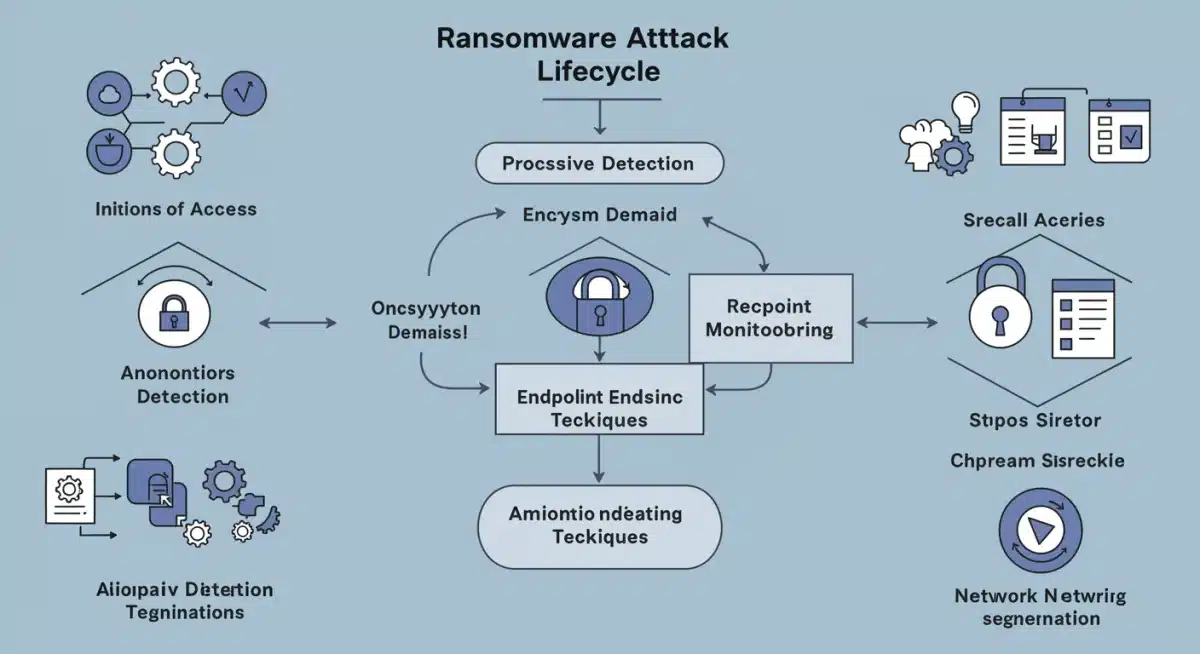
Beyond technical steps, the plan should also address communication strategies for employees, customers, and regulatory bodies. Transparency and clear messaging are vital for maintaining trust and complying with legal obligations during a crisis. A proactive approach to incident response significantly reduces the overall impact of a ransomware attack.
Employee Training and Security Awareness
Human error remains one of the most common entry points for ransomware. Therefore, comprehensive employee training and continuous security awareness programmes are indispensable proactive measures. Employees are often the first line of defence, and their vigilance can prevent attacks from ever taking hold.
Training should cover various aspects of cybersecurity, including recognising phishing attempts, safe browsing habits, the importance of strong passwords, and proper reporting procedures for suspicious activities. Regular refreshers and simulated phishing campaigns can help reinforce these lessons and keep employees on high alert. A culture of security, where every employee understands their role in protecting the organisation, is paramount.
Building a Security-Conscious Culture
- Phishing Simulations: Regularly testing employees’ ability to identify and report phishing emails.
- Interactive Training Modules: Engaging content that educates employees on common threats.
- Clear Reporting Channels: Ensuring employees know how and where to report suspicious activities.
By empowering employees with the knowledge and tools to identify and resist social engineering tactics, US businesses can significantly reduce their attack surface. A well-informed workforce acts as a critical barrier against ransomware, complementing technological defences and strengthening the overall security posture.
The Importance of Regular Data Backups and Recovery Strategies
Even the most robust detection and prevention measures can sometimes be bypassed. In such scenarios, having reliable, air-gapped, and regularly tested data backups is the ultimate failsafe against ransomware. Without proper backups, businesses are often left with no choice but to pay the ransom or face irreversible data loss.
A comprehensive backup strategy involves not only storing data off-site but also ensuring that these backups are immutable and isolated from the primary network. This prevents ransomware from encrypting the backups themselves. Regular testing of the recovery process is equally important to guarantee that data can be restored quickly and efficiently when needed, minimising downtime and business disruption.
Implementing a 3-2-1 Backup Rule
The industry-standard 3-2-1 backup rule suggests having at least three copies of your data, stored on two different media types, with one copy off-site. For ransomware resilience, it’s crucial that the off-site copy is physically or logically isolated from the network, preventing it from being accessed and encrypted by attackers. This strategy provides multiple layers of redundancy and protection.
- Immutable Backups: Data copies that cannot be altered or deleted, even by ransomware.
- Off-site Storage: Storing backups in a separate location, ideally cloud-based or in a secure data centre.
- Regular Recovery Testing: Periodically restoring data from backups to verify their integrity and accessibility.
Investing in robust backup and recovery solutions, alongside stringent access controls for backup systems, provides US businesses with the peace of mind that even if an attack succeeds, their critical data can be recovered, allowing for business continuity and resilience.
| Key Proactive Measure | Brief Description |
|---|---|
| Threat Intelligence | Continuously monitor and analyse ransomware trends to anticipate attacks. |
| Advanced EDR/NDR | Implement AI-driven endpoint and network detection for early threat identification. |
| Incident Response Planning | Develop and regularly test a comprehensive plan for ransomware attacks. |
| Employee Training | Educate staff on cybersecurity best practices to reduce human error vulnerabilities. |
Frequently Asked Questions About Ransomware Detection
Ransomware detection involves identifying and neutralising malicious software designed to encrypt data until a ransom is paid. It’s crucial for US businesses in 2025 due to the increasing sophistication and frequency of attacks, which can lead to significant financial losses, operational disruption, and reputational damage if not detected and mitigated promptly.
AI enhances ransomware detection by enabling systems to learn normal network and endpoint behaviours. This allows for the identification of subtle anomalies that indicate an attack, even for previously unknown ransomware variants. AI-driven systems can process vast amounts of data quickly, providing real-time threat intelligence and faster response times.
EDR (Endpoint Detection and Response) monitors individual devices for suspicious activity, while NDR (Network Detection and Response) observes network traffic for anomalies. Together, they provide comprehensive coverage, detecting ransomware at various stages of an attack, from initial infection on an endpoint to lateral movement across the network, enabling rapid containment.
Regular incident response drills ensure that businesses are prepared to react effectively during a real ransomware attack. These simulations help identify gaps in plans, train staff, and refine procedures, reducing panic and ensuring a coordinated, rapid response. This significantly minimises downtime and the overall impact of an incident.
Employees are often targeted through social engineering tactics like phishing. A well-trained workforce, educated on identifying and reporting suspicious activities, forms a critical human firewall. Increased security awareness reduces the likelihood of successful initial breaches, making employees key partners in a robust ransomware defence strategy.
Conclusion
For US businesses navigating the complex cyber threat landscape of 2025, proactive ransomware detection proactive measures are not merely a defensive tactic but a strategic imperative. By understanding the evolving nature of ransomware, investing in advanced threat intelligence, implementing robust EDR and NDR solutions, establishing comprehensive incident response plans, and fostering a strong culture of security awareness among employees, organisations can significantly enhance their resilience. The goal is to detect and mitigate attacks within a critical three-month window, ensuring business continuity and safeguarding invaluable digital assets against the ever-present threat of ransomware.