Fileless Malware Detection: 4 Techniques for US Security Teams by 2026

The Evolving Threat of Fileless Malware: 4 Detection Techniques US Security Teams Need to Implement by August 2026 for 90% Improved Efficacy
In the relentlessly evolving landscape of cyber threats, fileless malware has emerged as a particularly insidious adversary. Unlike traditional malware that relies on executable files written to disk, fileless malware operates entirely within memory, leveraging legitimate system tools and processes. This evasive nature makes it exceptionally difficult to detect using conventional signature-based antivirus solutions, posing a significant challenge for even the most sophisticated US security teams. The urgency to adapt and implement advanced fileless malware detection techniques has never been greater, especially with the target of achieving 90% improved efficacy by August 2026.
The rise of fileless attacks is not merely a technical curiosity; it represents a fundamental shift in the attacker’s methodology. By avoiding disk-based indicators of compromise (IoCs), these threats can bypass many established security controls, leading to longer dwell times, increased data exfiltration, and more severe financial and reputational damage. From PowerShell-based attacks to in-memory exploits and living-off-the-land (LotL) techniques, fileless malware is a cornerstone of modern advanced persistent threats (APTs).
This comprehensive guide will delve into four critical fileless malware detection techniques that US security teams must prioritise and integrate into their cybersecurity frameworks. We will explore how memory forensics, advanced behavioral analysis, enhanced Endpoint Detection and Response (EDR) capabilities, and the strategic application of Artificial Intelligence (AI) and Machine Learning (ML) can collectively fortify defences against these elusive threats. The goal is clear: to equip security professionals with the knowledge and tools necessary to achieve a significant leap in detection efficacy, safeguarding critical infrastructure and sensitive data across the nation.
Understanding the Elusive Nature of Fileless Malware
Before diving into specific detection techniques, it’s crucial to grasp why fileless malware presents such a formidable challenge. Its defining characteristic is the absence of traditional files on the disk, making it invisible to security solutions that primarily scan file systems for malicious signatures. Instead, fileless malware lives in RAM, operating system processes, and legitimate software tools.
How Fileless Malware Operates: A Brief Overview
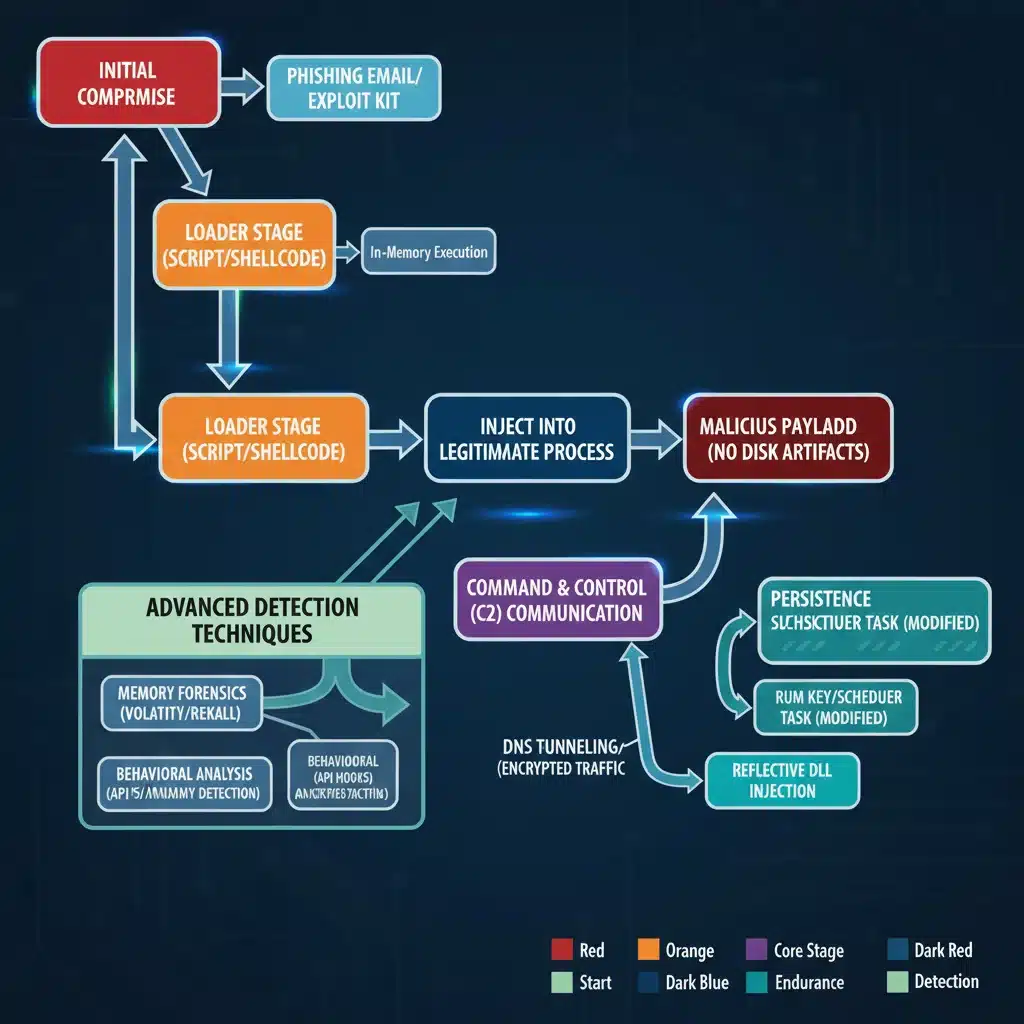
- In-Memory Execution: Attacks often begin with an exploit that injects malicious code directly into the memory of a legitimate process. This code then executes without ever touching the disk.
- Living Off The Land (LotL): Attackers frequently abuse legitimate system tools already present on the host, such as PowerShell, WMI (Windows Management Instrumentation), PsExec, and even JavaScript or VBScript interpreters. By using these trusted tools, the malicious activity blends in with normal system operations, making it difficult to distinguish legitimate use from malicious intent.
- Registry Persistence: Instead of creating files, some fileless malware achieves persistence by modifying registry keys, scheduling tasks, or using WMI event subscriptions to re-execute malicious code after a reboot.
- Exploiting Vulnerabilities: Web browsers, document readers, and other applications can be exploited to run shellcode directly in memory, initiating the fileless attack chain.
The absence of a file to scan means that traditional antivirus (AV) solutions are largely ineffective against these threats. US security teams must move beyond signature-based detection and embrace more dynamic, real-time analysis methods to effectively combat fileless malware. This paradigm shift is not optional; it’s essential for maintaining a robust cybersecurity posture.
1. Memory Forensics: Peering into the Volatile Realm
One of the most potent weapons against fileless malware is memory forensics. Since these threats reside and execute in the computer’s volatile memory (RAM), analysing memory dumps provides a direct view into their operations. Memory forensics involves capturing, preserving, and analysing the contents of a computer’s RAM to uncover malicious processes, injected code, and other artifacts that would otherwise be invisible on disk.
Key Aspects of Memory Forensics for Fileless Malware Detection:
- Process Analysis: Examining running processes for anomalies, such as unsigned executables running from unusual locations, processes with unexpected parent-child relationships (e.g., PowerShell spawned by a browser), or processes injecting code into other legitimate processes. Tools like Volatility Framework are invaluable here.
- Hidden Code Detection: Fileless malware often injects shellcode or other malicious payloads into legitimate process memory. Memory forensics can reveal these hidden code segments, even if they are obfuscated or encrypted.
- Network Connections and Handles: Analysing memory for active network connections, open files, and other system handles can expose command-and-control (C2) communications or data exfiltration attempts initiated by fileless threats.
- Registry Key Analysis in Memory: While some registry persistence mechanisms can be found on disk, memory forensics can also reveal temporary or in-memory modifications to registry keys used by fileless malware.
- API Hooking and Rootkits: Advanced fileless malware might employ API hooking or even in-memory rootkit techniques to evade detection. Memory forensics can identify these hooks and manipulated system calls.
Implementing effective memory forensics requires specialised tools and skilled analysts. US security teams should invest in training personnel and acquiring robust memory analysis platforms. The ability to perform live memory acquisition and analysis is becoming increasingly critical for rapid incident response and effective fileless malware detection.
2. Advanced Behavioral Analysis: Unmasking Malicious Actions
Since fileless malware eschews traditional signatures, focusing on its behaviour becomes paramount. Advanced behavioral analysis involves monitoring and evaluating the actions of processes and users on an endpoint or across the network to identify patterns indicative of malicious activity, regardless of whether a file is involved.
Components of Robust Behavioral Analysis:
- Process Monitoring: Continuously tracking process creation, termination, and their relationships. Anomalies like a Microsoft Word document spawning a PowerShell process or an unexpected process attempting to access critical system files are red flags.
- API Call Monitoring: Observing the sequence and nature of API calls made by processes. Certain sequences of API calls, even if individually legitimate, can collectively indicate malicious intent (e.g., a process attempting to read credentials from LSASS memory).
- Registry and File System Monitoring: While fileless malware avoids writing executables, it might still interact with the registry for persistence or access specific files for data exfiltration. Monitoring unusual modifications or access patterns can be highly effective.
- Network Activity Monitoring: Analysing outbound connections for unusual destinations, protocols, or data volumes. Fileless malware still needs to communicate with C2 servers.
- User Behavior Analytics (UBA): Integrating user activity into the analysis. Uncharacteristic user behaviour, such as an employee accessing sensitive data they normally wouldn’t, could signal a compromised account being used by fileless malware.
The challenge with behavioral analysis is distinguishing malicious behaviour from legitimate activity. This often requires sophisticated baselining and contextual understanding. False positives can be high if not properly tuned. US security teams need to deploy solutions that can learn and adapt, reducing alert fatigue while accurately identifying true threats.
3. Enhanced Endpoint Detection and Response (EDR) Capabilities
Endpoint Detection and Response (EDR) solutions are foundational for modern threat detection, offering real-time visibility and control over endpoint activities. For fileless malware detection, EDR systems need to move beyond basic logging and incorporate advanced analytics and response capabilities.
Essential EDR Enhancements for Combatting Fileless Malware:
- Deep Visibility into OS Internals: EDRs must have granular visibility into low-level operating system events, including kernel-level activity, API calls, process injection attempts, and memory modifications. This deep insight is crucial for detecting the subtle footprints of fileless threats.
- Behavioral Analytics Engine: A strong EDR solution for fileless malware needs an integrated behavioral analytics engine that can identify anomalous process execution, suspicious PowerShell commands, WMI abuse, and other LotL techniques. This engine should leverage heuristics and machine learning to build a behavioural baseline and flag deviations.
- Memory Scanning and Analysis: Leading EDR platforms are now incorporating in-memory scanning capabilities, allowing them to inspect process memory for malicious code, injected payloads, and indicators of compromise that exist solely in RAM.
- Automated Threat Hunting and Response: EDR systems should enable automated threat hunting queries to proactively search for fileless IoCs across endpoints. Furthermore, automated response actions, such as isolating a compromised endpoint or terminating a malicious process, are vital for containing fileless attacks rapidly.
- Integration with Threat Intelligence: Tying EDR data into robust threat intelligence feeds can help identify known fileless attack patterns and TTPs (Tactics, Techniques, and Procedures).
For US security teams, selecting an EDR solution with robust fileless malware detection capabilities is critical. It’s not just about collecting data; it’s about intelligent analysis and rapid, decisive action. The EDR platform should serve as the central nervous system for endpoint security, providing the necessary telemetry and control to counter sophisticated adversaries.
4. Strategic Application of Artificial Intelligence (AI) and Machine Learning (ML)
The sheer volume and complexity of data generated by modern endpoints make manual analysis for fileless malware detection impractical. This is where Artificial Intelligence (AI) and Machine Learning (ML) become indispensable. AI/ML algorithms can process vast datasets, identify subtle patterns, and make predictive analyses that human analysts simply cannot.
How AI/ML Supercharges Fileless Malware Detection:
- Anomaly Detection: AI/ML models excel at establishing baselines of normal system and user behaviour. Any significant deviation from this baseline, even if it doesn’t match a known signature, can be flagged as anomalous. This is particularly effective against zero-day fileless attacks.
- Pattern Recognition in Process Chains: ML algorithms can learn to identify malicious sequences of process execution, API calls, and system interactions that characterise fileless attacks. For example, a browser launching PowerShell, which then attempts to modify the registry, can be a strong indicator.
- Natural Language Processing (NLP) for Script Analysis: AI can be leveraged to analyse the syntax and semantics of scripts (e.g., PowerShell scripts) that are executed in memory. While these scripts might be obfuscated, NLP techniques can often identify malicious intent or unusual command structures.
- Predictive Analytics: By analysing historical attack data and current threat intelligence, AI can help predict potential attack vectors and vulnerabilities that fileless malware might exploit, allowing for proactive defence adjustments.
- Automated Triage and Prioritisation: AI can help security teams cope with alert fatigue by automatically triaging and prioritising potential threats, distinguishing high-fidelity alerts from noise, and guiding analysts to the most critical incidents.
Implementing AI/ML for fileless malware detection requires access to high-quality data, significant computational resources, and expertise in data science. US security teams should look for security solutions that embed advanced AI/ML capabilities, rather than attempting to build these from scratch. The fusion of human intelligence with machine intelligence offers the most robust defence.

Integrating the Techniques for 90% Improved Efficacy
Achieving 90% improved efficacy against fileless malware by August 2026 is an ambitious yet attainable goal, but it requires a holistic and integrated approach. No single technique will provide a complete defence. Instead, US security teams must weave these four strategies into a cohesive, multi-layered security fabric.
A Synergistic Approach:
- Prevention through Hardening: While not a detection technique, a strong foundation of endpoint hardening, least privilege principles, and patch management reduces the attack surface for fileless malware to exploit initially.
- EDR as the Central Hub: The EDR solution should serve as the primary platform, collecting telemetry from all endpoints. Its enhanced capabilities, including memory scanning and behavioral analysis, will be the first line of advanced detection.
- AI/ML for Intelligent Analysis: Feed the vast data collected by EDR into AI/ML engines. These engines will perform real-time anomaly detection, pattern recognition, and predictive analysis, generating high-fidelity alerts for suspicious fileless activity.
- Memory Forensics for Deep Dive and Validation: When AI/ML or behavioral analysis flags a high-priority alert, memory forensics tools and skilled analysts can then perform a deep dive. This allows for definitive identification of in-memory payloads, rootkits, or other sophisticated fileless artefacts that might still evade automated systems.
- Automated Response and Orchestration: Integrate these detection systems with Security Orchestration, Automation, and Response (SOAR) platforms to automate initial response actions, such as isolating endpoints, terminating processes, or blocking network connections, thereby minimising the impact of fileless attacks.
- Continuous Threat Intelligence Integration: Regular updates from threat intelligence feeds should inform all layers of defence, including EDR rules, AI/ML models, and behavioral baselines, ensuring the systems are aware of the latest fileless malware TTPs.
- Regular Training and Drills: Security teams must regularly train on new fileless malware detection techniques and conduct incident response drills to ensure they are proficient in using these advanced tools and processes.
The journey to 90% improved efficacy is not a one-time project but an ongoing commitment to adaptation and improvement. It requires a significant investment in technology, talent, and process. However, the cost of inaction, given the escalating threat of fileless malware, far outweighs the investment.
The Future of Fileless Malware Detection for US Security Teams
As we approach August 2026, the landscape of cyber threats will undoubtedly continue to evolve. Fileless malware will likely become even more sophisticated, leveraging advanced evasion techniques and potentially incorporating quantum-resistant encryption or AI-driven polymorphic capabilities. Therefore, US security teams must not only implement these four techniques but also foster a culture of continuous learning and innovation.
The convergence of cloud security, identity management, and endpoint protection will also play a crucial role. As more workloads shift to the cloud, fileless attacks targeting cloud-native applications and serverless functions will increase. Detection techniques must extend beyond traditional endpoints to encompass these new environments.
Furthermore, collaboration and information sharing among US government agencies, critical infrastructure operators, and private sector cybersecurity firms will be instrumental. Sharing insights into emerging fileless malware TTPs and successful detection strategies can accelerate the collective ability to defend against these pervasive threats.
The goal of 90% improved efficacy is ambitious, but it reflects the seriousness of the fileless malware threat. By strategically adopting memory forensics, advanced behavioral analysis, enhanced EDR capabilities, and the power of AI/ML, US security teams can build a robust, resilient defence that not only detects but also effectively neutralises these elusive adversaries, securing the digital future of the nation.