XDR vs. SIEM for 2026 Threat Detection in US Enterprises

For US enterprises eyeing 2026, understanding the nuances of XDR versus SIEM is crucial for effective threat detection and strategic security investment, driven by data-backed analysis.
As US enterprises navigate an increasingly complex digital landscape, the decision between Extended Detection and Response (XDR) and Security Information and Event Management (SIEM) for their cybersecurity infrastructure becomes paramount. This comprehensive analysis delves into XDR SIEM threat detection capabilities, offering a data-backed perspective for optimal security investment by 2026. Understanding the strengths and weaknesses of each system is no longer merely advantageous, but a critical imperative for robust defence.
The evolving threat landscape and the need for advanced detection
The cybersecurity threat landscape is in a constant state of flux, with adversaries employing increasingly sophisticated tactics. US enterprises face a deluge of threats ranging from advanced persistent threats (APTs) and ransomware to supply chain attacks and insider threats. Traditional security tools, while foundational, often struggle to keep pace with the sheer volume and stealth of modern attacks. This escalating complexity necessitates a deeper look into the efficacy of detection and response mechanisms.
Organisations are no longer merely looking to prevent breaches, but to detect and respond to them with unprecedented speed and accuracy. The focus has shifted from perimeter defence to a more holistic, adaptive security posture that can identify threats across multiple vectors. This proactive stance is vital for maintaining business continuity and protecting sensitive data.
The limitations of traditional security tools
While firewalls and antivirus software remain essential, they represent only one layer of a robust security strategy. Many legacy systems operate in silos, making it challenging to correlate events across different security domains. This fragmentation can lead to blind spots, allowing sophisticated threats to go undetected for extended periods.
- Lack of correlated visibility across diverse data sources.
- Over-reliance on signature-based detection, missing zero-day threats.
- Manual alert triage leading to analyst fatigue and delayed response.
- Limited automation capabilities for rapid threat containment.
The limitations of these traditional approaches highlight a critical gap in many enterprise security architectures. A more integrated and intelligent approach is needed to effectively combat the threats of tomorrow.
In conclusion, the dynamic nature of cyber threats demands a re-evaluation of existing security infrastructures. US enterprises require solutions that can offer comprehensive visibility, intelligent correlation, and automated response capabilities to stay ahead of malicious actors. This sets the stage for a deeper exploration of XDR and SIEM.
Understanding SIEM: a foundational security pillar
Security Information and Event Management (SIEM) has long been a cornerstone of enterprise security, providing centralised logging, alert management, and compliance reporting. SIEM solutions aggregate security data from various sources across an organisation’s IT environment, including network devices, servers, applications, and security tools. This aggregation allows for a consolidated view of security events.
At its core, SIEM is designed to collect, normalise, and analyse log data to identify potential security incidents. It uses rule-based correlation and statistical analysis to detect anomalies and flag suspicious activities. For many years, SIEM has been the go-to solution for IT security teams seeking a comprehensive overview of their security posture.
Key functionalities and benefits of SIEM
SIEM platforms offer a broad range of features that contribute to an organisation’s security strategy. Their ability to collect vast amounts of data makes them invaluable for forensic analysis and incident investigation.
- Centralised log collection and management for compliance.
- Real-time alert generation based on predefined rules.
- Forensic capabilities for incident investigation and post-breach analysis.
- Reporting for regulatory compliance and security audits.
These functionalities make SIEM a powerful tool for maintaining visibility and meeting regulatory requirements. It provides the necessary data foundation for understanding past incidents and proactively identifying emerging threats.
However, the effectiveness of a SIEM heavily relies on proper configuration, well-defined correlation rules, and the expertise of security analysts to interpret the vast amount of data it generates. Without these elements, a SIEM can become an ‘alert factory,’ overwhelming security teams with false positives and noise.
Ultimately, SIEM provides a critical data foundation and a centralised hub for security operations. While powerful, its reliance on log data and rule-based correlation sometimes presents challenges in detecting stealthy, advanced threats that don’t conform to known patterns.
Introducing XDR: extended detection and response capabilities
Extended Detection and Response (XDR) represents an evolution in threat detection, moving beyond the traditional limitations of endpoint-focused security. XDR integrates and correlates data from a broader range of security layers, including endpoints, networks, cloud environments, and email. This holistic approach provides a more comprehensive view of potential threats.
Unlike SIEM, which primarily focuses on log aggregation and correlation, XDR systems are purpose-built for threat detection and response. They leverage advanced analytics, machine learning, and automation to identify subtle attack patterns and facilitate rapid incident response across the entire digital estate. XDR aims to reduce the mean time to detect (MTTD) and mean time to respond (MTTR) significantly.
Core components and advantages of XDR
XDR platforms are designed with an emphasis on deeper visibility and automated actions, allowing for more proactive threat hunting and faster remediation. This integrated approach simplifies security operations and improves overall security efficacy.
- Unified visibility across endpoints, network, cloud, and email.
- Advanced analytics and machine learning for behaviour-based detection.
- Automated incident response and remediation actions.
- Simplified security operations with fewer tools and dashboards.
The integrated nature of XDR provides a distinct advantage in detecting complex, multi-stage attacks that might otherwise evade detection by siloed security tools. It offers a more coherent narrative of an attack, enabling faster and more effective containment.
By centralising data and applying sophisticated analysis, XDR can identify threats that might appear benign in isolation but reveal malicious intent when correlated across different security domains. This makes it particularly effective against advanced threats that leverage multiple attack vectors to achieve their objectives.
In essence, XDR offers a more focused and automated approach to threat detection and response, consolidating disparate security data into a single, actionable view. This streamlined process is critical for modern enterprises facing a high volume of sophisticated attacks.
XDR vs. SIEM: a data-backed analysis for 2026
When comparing XDR and SIEM for 2026 threat detection in US enterprises, it’s crucial to move beyond feature lists and examine their practical efficacy. Data from industry reports and real-world deployments indicates a clear trend towards solutions offering deeper context and automated response. While SIEM remains a robust platform for compliance and log management, XDR excels in proactive threat hunting and rapid incident response.
Studies show that organisations leveraging XDR often report a significant reduction in alert fatigue and faster resolution times for security incidents. This is largely due to XDR’s ability to automatically correlate diverse data sources and provide enriched context around alerts, reducing the burden on security analysts. SIEM, while powerful, often requires substantial human intervention for alert triage and investigation.
Key differences in operational effectiveness
The operational effectiveness of XDR and SIEM diverges significantly, particularly concerning their approach to data ingestion, analysis, and response. These differences directly impact an enterprise’s ability to detect and neutralise threats efficiently.
- Data Ingestion: SIEM is broad, collecting all logs; XDR is focused, ingesting high-fidelity data for threat detection.
- Analysis: SIEM relies on rules and basic correlation; XDR uses AI/ML for behaviour analytics and advanced threat modelling.
- Response: SIEM provides alerts for manual response; XDR offers automated, orchestrated actions.
- Alert Fidelity: XDR typically generates fewer, higher-fidelity alerts, reducing false positives.
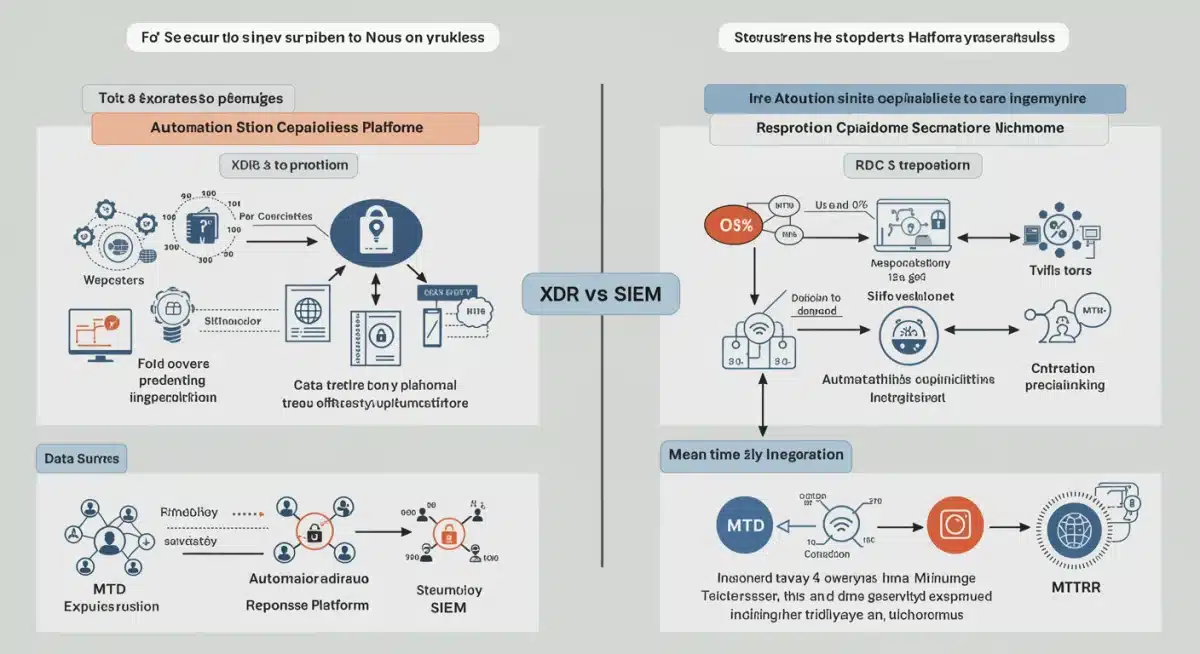
For US enterprises, this means XDR can provide a more agile and effective defence against sophisticated attacks where speed and precision are paramount. While SIEM offers a foundational layer of visibility, XDR builds upon this with enhanced detection and response capabilities tailored for the modern threat landscape.
Data suggests that the cost of a data breach continues to rise, making efficient and effective threat detection a critical investment. XDR’s ability to streamline security operations and reduce the impact of breaches offers a compelling return on investment for organisations seeking to fortify their defences by 2026.
In summary, while both SIEM and XDR play vital roles, their operational strengths cater to different aspects of security. For proactive, intelligence-driven threat detection and rapid response, XDR demonstrates a superior capability, supported by increasing adoption rates and positive outcome data.
Strategic security investment for US enterprises by 2026
For US enterprises looking towards 2026, making the right security investment is not just about purchasing technology, but about building a resilient and adaptive security posture. The decision between XDR and SIEM, or even their co-existence, must be strategically aligned with the organisation’s risk profile, existing infrastructure, and operational capabilities. A ‘one-size-fits-all’ approach is rarely effective in cybersecurity.
Investment decisions should be data-driven, considering factors such as the volume and sophistication of threats faced, the maturity of the security operations centre (SOC), and compliance requirements. Enterprises must assess whether their current SIEM implementation is optimised or if the additional context and automation offered by XDR would provide a more significant uplift in their defensive capabilities.
Factors influencing investment decisions
Several critical factors should guide US enterprises in their security investment strategy for the coming years. These considerations will help determine the most effective allocation of resources for threat detection.
- Existing infrastructure: Can current SIEM investments be leveraged or integrated with XDR?
- SOC maturity: Does the SOC have the skilled personnel to manage complex SIEM rules or benefit from XDR automation?
- Threat profile: Are the primary threats advanced, multi-stage attacks that XDR is better equipped to handle?
- Budget and resources: What is the total cost of ownership (TCO) for each solution, including staffing and training?
Enterprises with a mature SIEM deployment might consider augmenting it with XDR for enhanced detection and response, especially at the endpoint and cloud layers. For those starting fresh or looking to overhaul their security operations, a well-implemented XDR solution could offer a more streamlined and effective path to advanced threat detection.
Ultimately, the strategic investment for 2026 involves a careful balancing act between comprehensive data aggregation (SIEM) and focused, automated threat response (XDR). The goal is to achieve the highest possible security efficacy while optimising operational costs and resource utilisation. This often means a hybrid approach, leveraging the strengths of both platforms.
In conclusion, a thoughtful and data-informed investment strategy is crucial. US enterprises must weigh their specific needs against the capabilities of both XDR and SIEM to build a robust security architecture that can withstand the evolving threat landscape of 2026 and beyond.
The role of automation and AI in modern threat detection
The escalating volume and complexity of cyber threats have made manual threat detection and response increasingly unsustainable. Automation and Artificial Intelligence (AI) are no longer optional but essential components of modern security operations. Both XDR and SIEM leverage these technologies, albeit to different extents and with varying focuses, to enhance their detection capabilities and streamline workflows.
In XDR, AI and machine learning are deeply embedded to analyse vast datasets for anomalies, behavioural deviations, and subtle indicators of compromise (IOCs) that might elude rule-based systems. This allows XDR to identify sophisticated, never-before-seen threats. Automation in XDR extends to orchestrating response actions, such as isolating compromised endpoints or blocking malicious IPs, significantly reducing response times.
AI and automation in SIEM vs. XDR
While both platforms utilise these advanced technologies, their application and impact differ, influencing their overall effectiveness in a modern security context.
- SIEM’s AI/Automation: Primarily focused on alert prioritisation, log normalisation, and basic correlation to reduce noise.
- XDR’s AI/Automation: Extends to behavioural analytics, threat hunting, root cause analysis, and automated remediation across multiple security domains.
- Threat Modelling: XDR uses AI for dynamic threat modelling to adapt to new attack techniques more rapidly.
- Analyst Efficiency: XDR’s automation aims to augment analysts by providing enriched context and suggested actions, while SIEM often requires more manual investigation post-alert.
For US enterprises, the superior automation and AI capabilities offered by XDR translate into a more proactive and efficient security posture. It enables security teams to move beyond reactive incident response to proactive threat hunting and prediction, significantly improving their defensive capabilities.
The integration of AI and automation allows for continuous learning and adaptation, making both XDR and modern SIEM more resilient against evolving threats. However, XDR’s native design for integrated detection and response across diverse data sources often gives it an edge in applying these technologies for maximum impact on threat resolution.
In essence, the future of threat detection is inextricably linked to the intelligent application of AI and automation. Both XDR and SIEM are evolving to incorporate these capabilities, but XDR’s architectural design often allows for a more comprehensive and automated approach to combating sophisticated cyber threats.
Implementing and integrating XDR and SIEM effectively
The successful implementation and integration of XDR and SIEM solutions within a US enterprise’s security ecosystem are critical for maximising their value. It’s not simply about deploying software; it involves strategic planning, proper configuration, and continuous optimisation. Many organisations find that a hybrid approach, where SIEM and XDR complement each other, offers the most robust defence.
When considering integration, SIEM can serve as a central repository for all security logs and compliance data, while XDR focuses on advanced threat detection and automated response across specific domains like endpoints, network, and cloud. This allows SIEM to fulfil its role in compliance and long-term data retention, with XDR providing the immediate, actionable intelligence for threat mitigation.
Best practices for deployment and synergy
To achieve optimal security outcomes, enterprises should follow best practices when deploying and integrating these powerful security tools. This ensures that both systems operate efficiently and provide maximum protection.
- Define Clear Roles: Assign distinct responsibilities for SIEM (compliance, broad logging) and XDR (threat detection, automated response).
- Data Flow Optimisation: Ensure relevant data from XDR is fed into SIEM for broader context and compliance archiving.
- Skilled Personnel: Invest in training security teams on both platforms to leverage their full potential.
- Phased Rollout: Consider a phased approach, starting with critical assets, to manage complexity and refine configurations.
Effective integration often involves leveraging APIs and connectors to ensure seamless data exchange between the platforms. This allows for a unified view when needed, without duplicating efforts or creating unnecessary complexity for security analysts.
Furthermore, regular reviews of correlation rules, detection policies, and automation playbooks are essential. The threat landscape changes rapidly, and security tools must adapt to remain effective. This continuous improvement cycle is vital for maintaining a strong defensive posture.
In conclusion, the most effective strategy for US enterprises by 2026 may not be an ‘either/or’ choice, but rather a ‘better together’ approach. By strategically implementing and integrating XDR alongside SIEM, organisations can build a multi-layered defence that addresses both broad security visibility and targeted, automated threat response.
| Feature | Description |
|---|---|
| Data Scope | SIEM: Broad log aggregation. XDR: Focused, high-fidelity data from endpoints, network, cloud, email. |
| Detection Method | SIEM: Rule-based correlation. XDR: AI/ML behavioural analytics, threat modelling. |
| Response | SIEM: Alerts for manual response. XDR: Automated, orchestrated actions. |
| Primary Goal | SIEM: Compliance, log management. XDR: Advanced threat detection and rapid response. |
Frequently asked questions about XDR and SIEM
The fundamental difference lies in their scope and focus. SIEM aggregates logs from across the IT environment for compliance and broad visibility, relying on rules. XDR focuses on deep threat detection and automated response across endpoints, network, cloud, and email using advanced analytics and AI.
While XDR excels in threat detection and response, it typically doesn’t fully replace SIEM’s broad log management and compliance reporting capabilities. Many US enterprises find a hybrid approach, where XDR enhances SIEM, to be the most comprehensive solution for their security needs.
XDR generally offers superior threat detection for advanced, multi-stage attacks. Its ability to correlate high-fidelity data across multiple security layers using AI and machine learning provides deeper context and earlier identification of sophisticated threats that might bypass traditional SIEM rules.
XDR improves efficiency by automating many aspects of threat detection and response, reducing alert fatigue, and providing enriched context for incidents. This allows security analysts to focus on genuine threats and respond more rapidly, streamlining security operations significantly.
Enterprises should consider their existing infrastructure, SOC maturity, specific threat profile, and budget. A data-backed analysis of these factors will guide whether to invest in a standalone XDR, enhance an existing SIEM, or pursue a synergistic, hybrid deployment for optimal security by 2026.
Conclusion
The strategic decision regarding XDR versus SIEM for 2026 threat detection in US enterprises is multifaceted, driven by an ever-evolving threat landscape and the imperative for robust security investment. While SIEM remains a foundational pillar for comprehensive log management and compliance, XDR emerges as a powerful, integrated solution for advanced, automated threat detection and rapid response across diverse digital assets. A data-backed analysis underscores XDR’s efficacy in combating sophisticated attacks, yet a synergistic approach, leveraging the strengths of both platforms, often provides the most resilient and future-proof security architecture. US enterprises must meticulously evaluate their unique operational context, risk profile, and resource capabilities to forge an optimal security strategy that ensures enduring protection in the years to come.