Quantum Computing Threats 2026: US Data Encryption & Post-Quantum Security
The digital landscape is in a constant state of evolution, and with innovation comes new challenges. One of the most profound and potentially disruptive shifts on the horizon is the rise of quantum computing. While still in its nascent stages, the projected capabilities of quantum computers pose an existential threat to the cryptographic foundations that secure virtually all modern digital communications and data storage. For the United States, safeguarding national security, economic stability, and citizens’ privacy hinges on proactive preparation. This article delves into the critical juncture we face by 2026, examining the impending quantum computing threats to US data encryption and outlining four practical, actionable solutions for the essential post-quantum security adoption.
The year 2026 is not an arbitrary deadline but a strategic projection. Experts widely anticipate that within this timeframe, the development of quantum computers will reach a point where they can effectively break many of the public-key cryptographic algorithms currently used to secure sensitive data. This includes algorithms like RSA and Elliptic Curve Cryptography (ECC), which are the backbone of secure websites (HTTPS), encrypted emails, digital signatures, and even the protection of critical infrastructure. The implications of such a breach are staggering, ranging from the compromise of classified government information and military communications to the theft of financial assets, intellectual property, and personal data on an unprecedented scale. Understanding the urgency of quantum security adoption is paramount for every sector.
The Quantum Threat Landscape: Why 2026 Matters for US Data Encryption
To fully grasp the gravity of the situation, it’s crucial to understand what makes quantum computers so dangerous to current encryption. Traditional computers store information as bits, which can be either 0 or 1. Quantum computers use qubits, which can be 0, 1, or both simultaneously (superposition). This, combined with phenomena like entanglement, allows quantum computers to perform certain calculations exponentially faster than classical computers. Specifically, Shor’s algorithm, discovered in 1994, demonstrates that a sufficiently powerful quantum computer could factor large numbers much more efficiently than any classical algorithm. The security of RSA and ECC relies on the computational difficulty of such factoring problems.
The ‘harvest now, decrypt later’ threat is particularly insidious. Malicious actors, including nation-states, are already accumulating encrypted data, knowing that once quantum computers become powerful enough, they can retroactively decrypt this information. This means that data encrypted today, if not protected with post-quantum cryptography, could be exposed years down the line. This timeline makes the 2026 projection not just a technical milestone but a strategic imperative for quantum security adoption.
For the United States, the stakes are incredibly high. Government agencies, defence contractors, financial institutions, healthcare providers, and technology companies all rely heavily on robust encryption. The compromise of this encryption could lead to:
- National Security Breaches: Exposure of classified intelligence, military communications, and sensitive operational plans.
- Economic Catastrophe: Theft of financial data, intellectual property, trade secrets, and disruption of critical economic infrastructure.
- Erosion of Trust: Loss of public confidence in digital systems, impacting everything from e-commerce to democratic processes.
- Undermining Critical Infrastructure: Vulnerabilities in energy grids, water systems, transportation, and communication networks.
The National Institute of Standards and Technology (NIST) has been at the forefront of this issue, launching a multi-year process to standardise post-quantum cryptographic (PQC) algorithms. This initiative is a clear acknowledgment of the impending threat and the urgent need for quantum security adoption. However, standardisation is just the first step; implementation is a complex and lengthy process.
Solution 1: Comprehensive Cryptographic Inventory and Risk Assessment
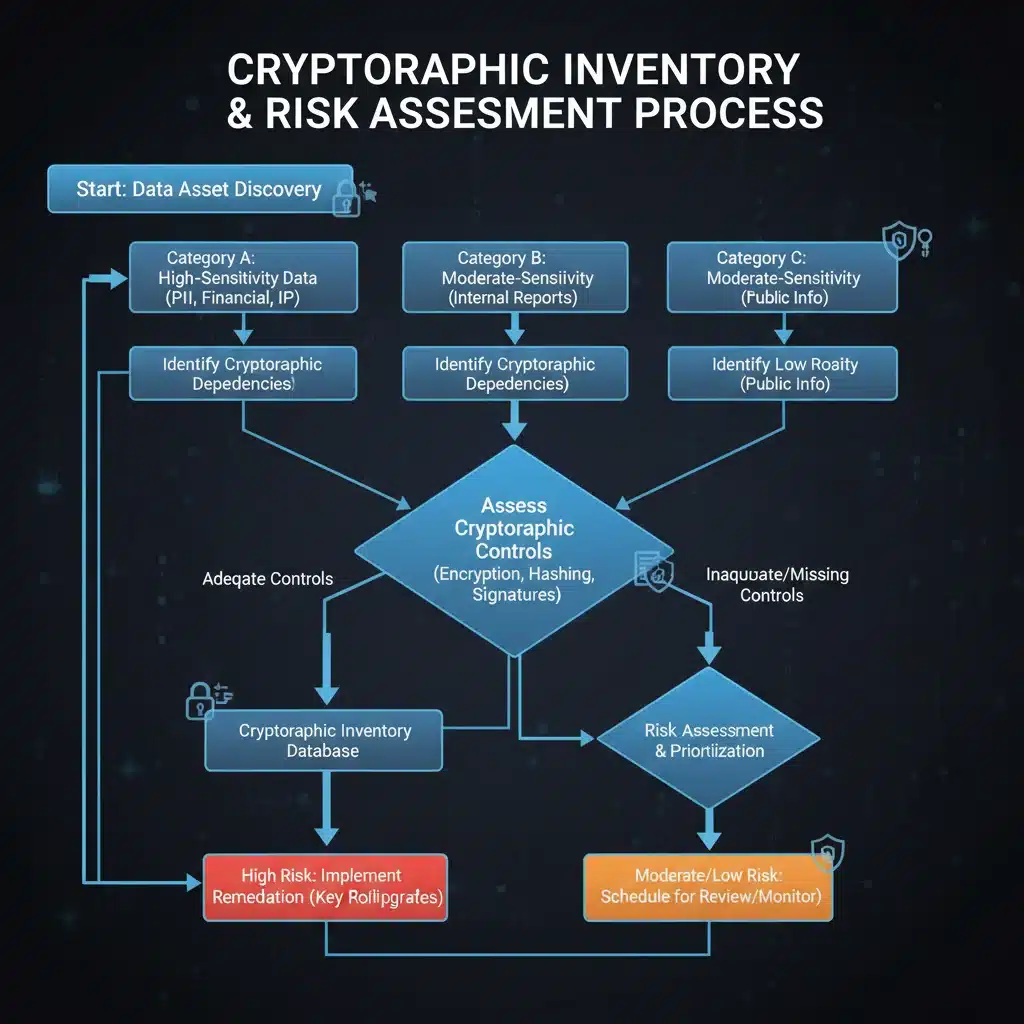
Before any organisation can begin the transition to post-quantum cryptography, it must first understand its current cryptographic posture. This involves a thorough and comprehensive inventory of all cryptographic assets and their dependencies. Many organisations, even large ones, often have a poor understanding of where encryption is used, what algorithms are employed, and which keys protect which data. This lack of visibility is a significant impediment to effective quantum security adoption.
A comprehensive cryptographic inventory should identify:
- All cryptographic algorithms in use: RSA, ECC, AES, SHA, etc., and their key lengths.
- Where these algorithms are deployed: Hardware, software, applications, databases, communication channels, cloud services.
- The data protected by each algorithm: Classify data by sensitivity (e.g., public, internal, confidential, secret) and its anticipated lifetime.
- Key management practices: How keys are generated, stored, distributed, and revoked.
- Dependencies: Which systems, applications, and services rely on which cryptographic primitives.
- Third-party integrations: Cryptographic dependencies on vendors, partners, and cloud providers.
Once an inventory is complete, a robust risk assessment is essential. This assessment should prioritise assets based on their sensitivity, the longevity of the data they protect, and the estimated time it would take for a quantum computer to break their current encryption. For example, data that needs to remain confidential for decades (e.g., classified government documents, long-term financial records, intellectual property) poses a higher quantum risk than data that is only relevant for a short period.
The risk assessment should also consider the ‘cryptographic agility’ of an organisation’s systems. Cryptographic agility refers to the ability of systems to easily switch between different cryptographic algorithms without significant disruption. Systems designed with cryptographic agility in mind will have a much smoother transition to post-quantum standards. Those that are hard-coded with specific algorithms will require substantial re-engineering, increasing both cost and risk during the quantum security adoption process.
Practical Steps:
- Appoint a Cryptographic Inventory Lead: Designate a responsible individual or team to spearhead this effort across the organisation.
- Utilise Automated Discovery Tools: Employ software tools that can scan networks and applications to identify cryptographic instances.
- Engage Stakeholders: Collaborate with IT, security, application development, and business unit leaders to ensure a complete picture.
- Categorise and Prioritise: Develop a clear classification system for cryptographic assets and data sensitivity.
- Document Dependencies: Create detailed maps of cryptographic dependencies within and across systems.
Without this foundational understanding, any attempts at quantum security adoption will be akin to navigating in the dark, leading to wasted resources, overlooked vulnerabilities, and ultimately, a failure to secure critical assets against quantum threats.
Solution 2: Develop a Phased Post-Quantum Cryptography (PQC) Migration Strategy
Migrating to post-quantum cryptography is not a switch that can be flipped overnight. It is a complex, multi-year undertaking that requires careful planning and a phased approach. A well-defined PQC migration strategy is crucial for organisations to manage the transition effectively, minimise disruption, and ensure continuous security. This strategy must be integrated into an organisation’s broader cybersecurity roadmap and IT modernisation plans, making quantum security adoption a core objective.
The phased approach should consider:
- Standardisation Status: Which PQC algorithms are nearing standardisation by NIST and other international bodies. Organisations should focus on these candidates to avoid investing in algorithms that may not become widely adopted.
- System Criticality: Prioritise the migration of the most critical systems and data first, especially those with long data lifetimes or high sensitivity.
- Hybrid Mode Implementation: Initially, many organisations will adopt a ‘hybrid mode’ or ‘crypto-agility’ approach. This involves running both classical and post-quantum algorithms concurrently. This provides a fallback in case PQC algorithms are found to have unforeseen vulnerabilities or if the quantum threat timeline shifts. It also allows for gradual testing and deployment.
- Vendor Readiness: Assess the readiness of third-party vendors and service providers to support PQC. Many organisations rely on commercial off-the-shelf (COTS) products or cloud services, and their PQC capabilities will dictate migration timelines for dependent systems.
- Resource Allocation: Plan for the necessary human resources (cryptographers, security architects, developers), financial investment, and time required for testing, deployment, and training.
A typical PQC migration strategy might involve several phases:
- Phase 1: Research and Planning (Current – 2024): This involves the cryptographic inventory and risk assessment (Solution 1), monitoring NIST’s PQC standardisation process, and developing a high-level migration roadmap. Organisations should also start identifying pilot projects for PQC implementation.
- Phase 2: Pilot and Testing (2024 – 2026): Begin implementing PQC in non-critical systems or isolated environments. This phase focuses on testing the performance, compatibility, and security of selected PQC algorithms within the organisation’s specific infrastructure. It’s also an opportunity to build internal expertise.
- Phase 3: Hybrid Deployment (2026 – 2028+): Start deploying PQC alongside classical cryptography in critical systems. This hybrid approach ensures continued protection while allowing for real-world validation of PQC algorithms. This is where quantum security adoption begins to scale significantly.
- Phase 4: Full PQC Transition (2028+): Gradually transition away from classical algorithms as PQC algorithms mature and prove their resilience. The timeline for this phase will depend heavily on the evolution of quantum computing capabilities and the robustness of PQC standards.
Crucially, the strategy must include a robust change management plan to communicate the importance of PQC to all relevant stakeholders, from executives to technical staff. Without clear communication and buy-in, even the best technical strategy for quantum security adoption can falter.
Solution 3: Invest in Cryptographic Agility and Quantum-Resistant Technologies
Cryptographic agility is not merely a desirable feature; it is a fundamental requirement for navigating the uncertain future of cryptography. Building systems that can easily swap out cryptographic algorithms is essential for long-term security, especially in the face of evolving quantum threats and the potential for future breakthroughs in cryptanalysis. Investing in cryptographic agility now will significantly reduce the cost and complexity of future migrations, making quantum security adoption a more manageable process.
Key aspects of investing in cryptographic agility include:
- Modular Cryptographic Libraries: Design and implement systems using modular cryptographic libraries and APIs that abstract away the specific algorithms. This allows for easier updates and replacements of underlying cryptographic primitives without requiring extensive re-coding of applications.
- Standardised Protocols: Leverage protocols that support algorithm negotiation and multiple cryptographic suites, such as Transport Layer Security (TLS) 1.3 and future versions, which are designed to be more agile.
- Hardware Security Modules (HSMs) and Trust Anchors: Invest in HSMs that are either quantum-resistant or can be easily upgraded to support PQC algorithms. HSMs are critical for securing cryptographic keys, and their ability to be updated is paramount.
- Quantum-Resistant Random Number Generators (RNGs): Ensure that systems use high-quality, quantum-resistant random number generators, as the strength of many cryptographic algorithms depends on truly random numbers.
- Software-Defined Security: Adopt software-defined security architectures that allow for flexible and dynamic deployment of security controls, including cryptographic modules.
Beyond agility, organisations should actively explore and begin integrating quantum-resistant technologies where feasible. This includes:
- PQC Algorithm Implementation: Begin experimenting with the NIST-selected PQC algorithms (e.g., CRYSTALS-Kyber for key establishment, CRYSTALS-Dilithium for digital signatures). While these are still being finalised, early implementation in non-production environments can provide valuable experience and identify potential integration challenges.
- Quantum Key Distribution (QKD): For highly sensitive, point-to-point communications, QKD offers a method of key exchange that is provably secure against quantum attacks, based on the laws of quantum mechanics. While QKD has limitations (e.g., distance, infrastructure cost), it may be suitable for niche, high-security applications within government and critical infrastructure.
- Homomorphic Encryption: While not directly a PQC solution for existing encryption, homomorphic encryption allows computations to be performed on encrypted data without decrypting it. This could offer new paradigms for data privacy in cloud environments that are inherently resistant to certain types of quantum attacks, though its practical application is still evolving.
The goal is to build a resilient cryptographic infrastructure that can adapt to future threats, not just the quantum threat. This proactive investment in cryptographic agility and quantum-resistant technologies is a cornerstone of effective quantum security adoption.

Solution 4: Foster Collaboration, Education, and Policy Development
The challenge of quantum computing threats is too vast and complex for any single organisation or even a single nation to tackle alone. It requires a concerted, collaborative effort across government, industry, academia, and international partners. Furthermore, a well-informed workforce and supportive policy framework are essential enablers for successful quantum security adoption.
Collaboration:
- Public-Private Partnerships: The US government, through agencies like NIST, NSA, CISA, and DHS, is actively engaging with private industry. These partnerships are vital for sharing threat intelligence, best practices, and accelerating the development and deployment of PQC solutions.
- Industry Consortia: Participation in industry-specific working groups and consortia focused on quantum security allows organisations to pool resources, share experiences, and collectively address common challenges.
- International Cooperation: Quantum computing is a global phenomenon. Collaborating with international allies on PQC research, standardisation, and deployment strategies ensures a more harmonised and secure global digital ecosystem.
Education and Training:
- Upskilling Cybersecurity Professionals: There is a significant shortage of cryptographic expertise. Organisations must invest in training their existing cybersecurity teams and developers on the principles of quantum cryptography, PQC algorithms, and migration strategies.
- Academic Programs: Support for university programs and research initiatives in quantum information science and cryptography is crucial for developing the next generation of experts.
- Awareness Campaigns: Educate senior leadership and non-technical stakeholders about the quantum threat and the importance of PQC. Gaining executive buy-in is critical for securing the necessary resources and strategic focus for quantum security adoption.
Policy Development:
- Government Mandates and Guidance: The US government has a critical role to play in issuing clear mandates and detailed guidance for federal agencies and critical infrastructure operators regarding PQC migration. Executive orders and legislative actions can provide the necessary impetus and direction.
- Supply Chain Security: Policies must address the quantum readiness of the entire supply chain. Organisations need to ensure that their vendors and partners are also embarking on their PQC migration journeys, as a chain is only as strong as its weakest link.
- Regulatory Alignment: Ensure that existing and new regulations (e.g., HIPAA, GDPR, PCI DSS) are updated to reflect the requirements of post-quantum security, providing a clear framework for compliance.
By fostering a collaborative environment, investing in education, and developing supportive policies, the US can create a robust ecosystem that accelerates quantum security adoption and ensures a resilient digital future.
The Path Forward: A Call to Action for US Data Encryption Resilience
The year 2026 may seem distant, but in the realm of cryptographic migration, it is just around the corner. The complexity and scale of transitioning to post-quantum cryptography demand immediate and sustained action. Organisations that delay their quantum security adoption efforts risk significant exposure to future quantum attacks, jeopardising their data, their operations, and their trust.
The four solutions outlined—comprehensive cryptographic inventory and risk assessment, a phased PQC migration strategy, investment in cryptographic agility and quantum-resistant technologies, and fostering collaboration, education, and policy development—provide a robust framework for addressing this monumental challenge. Each solution builds upon the others, forming a holistic approach to securing US data encryption in the quantum era.
For the United States, maintaining its technological leadership and protecting its strategic interests requires a proactive and aggressive stance on quantum security. This is not merely a technical upgrade; it is a fundamental shift in how we approach digital security, demanding innovation, investment, and a collective commitment. The time to act is now. By embracing quantum security adoption with urgency and strategic foresight, we can ensure that our digital future remains secure, resilient, and impervious to the threats of the quantum age.
The journey to a quantum-safe world will be long and challenging, but the imperative to protect our most sensitive data against future quantum attacks is undeniable. Every organisation, from government agencies to small businesses, must begin to assess its exposure, plan its migration, and invest in the tools and expertise necessary to navigate this new cryptographic landscape. The security of tomorrow depends on the actions we take today.