Insider Threat Detection: Behavioural Analytics for 2026 Compliance

Insider Threat Detection: Implementing Behavioural Analytics for 2026 Compliance (Practical Solutions)
The digital landscape is constantly evolving, and with it, the nature of cyber threats. While external adversaries often dominate security discussions, a more insidious and potentially devastating danger lurks within organisations: the insider threat. An insider threat, whether malicious or negligent, can cause catastrophic data breaches, intellectual property theft, and operational disruption. As regulatory frameworks tighten and the stakes get higher, organisations face immense pressure to bolster their defences. The year 2026 looms as a significant benchmark, with anticipated compliance requirements demanding more sophisticated and proactive security measures. This article delves into the critical role of Insider Threat Behavioural Analytics in meeting these challenges, offering practical solutions to protect your organisation against internal risks and achieve robust compliance.
Understanding the Evolving Insider Threat Landscape
Before diving into solutions, it’s crucial to grasp the multifaceted nature of insider threats. These are not always the stereotypical disgruntled employees seeking revenge. They can be:
- Malicious Insiders: Individuals intentionally seeking to steal data, sabotage systems, or cause harm for personal gain, competitive advantage, or ideological reasons.
- Negligent Insiders: Employees who, through carelessness, lack of awareness, or poor security practices, inadvertently expose sensitive data or create vulnerabilities. This could involve falling for phishing scams, misconfiguring systems, or losing unencrypted devices.
- Compromised Insiders: Legitimate user accounts that have been hijacked by external attackers, who then use these credentials to move laterally within the network, appearing as an insider.
The rise of remote work, cloud computing, and increasingly complex IT environments has only amplified these risks. Traditional perimeter-based security measures are often insufficient against threats originating from within, as insiders already possess legitimate access to systems and data. This is where Insider Threat Behavioural Analytics becomes indispensable.
Why Traditional Security Falls Short Against Insider Threats
Many organisations rely on a combination of firewalls, intrusion detection systems, and endpoint protection. While vital, these tools primarily focus on external threats. When it comes to insiders, these systems often:
- Lack Context: They can detect unusual network traffic or file access, but struggle to differentiate between legitimate and malicious actions performed by an authorised user. For example, an employee accessing a large number of files might be doing so for a legitimate project, or preparing to exfiltrate data.
- Generate Alert Fatigue: Without context, these systems can generate a high volume of false positives, overwhelming security teams and desensitising them to genuine threats.
- Are Reactive: Most traditional tools are designed to react to known attack signatures or policy violations, rather than proactively identifying anomalous behaviours that might signal an impending threat.
- Are Easily Evaded: Malicious insiders often know the security controls in place and can find ways to bypass them using their authorised access.
The limitations of traditional approaches highlight the need for a more intelligent, adaptive, and predictive security posture, one that behavioural analytics is uniquely positioned to provide.
The Power of Insider Threat Behavioural Analytics
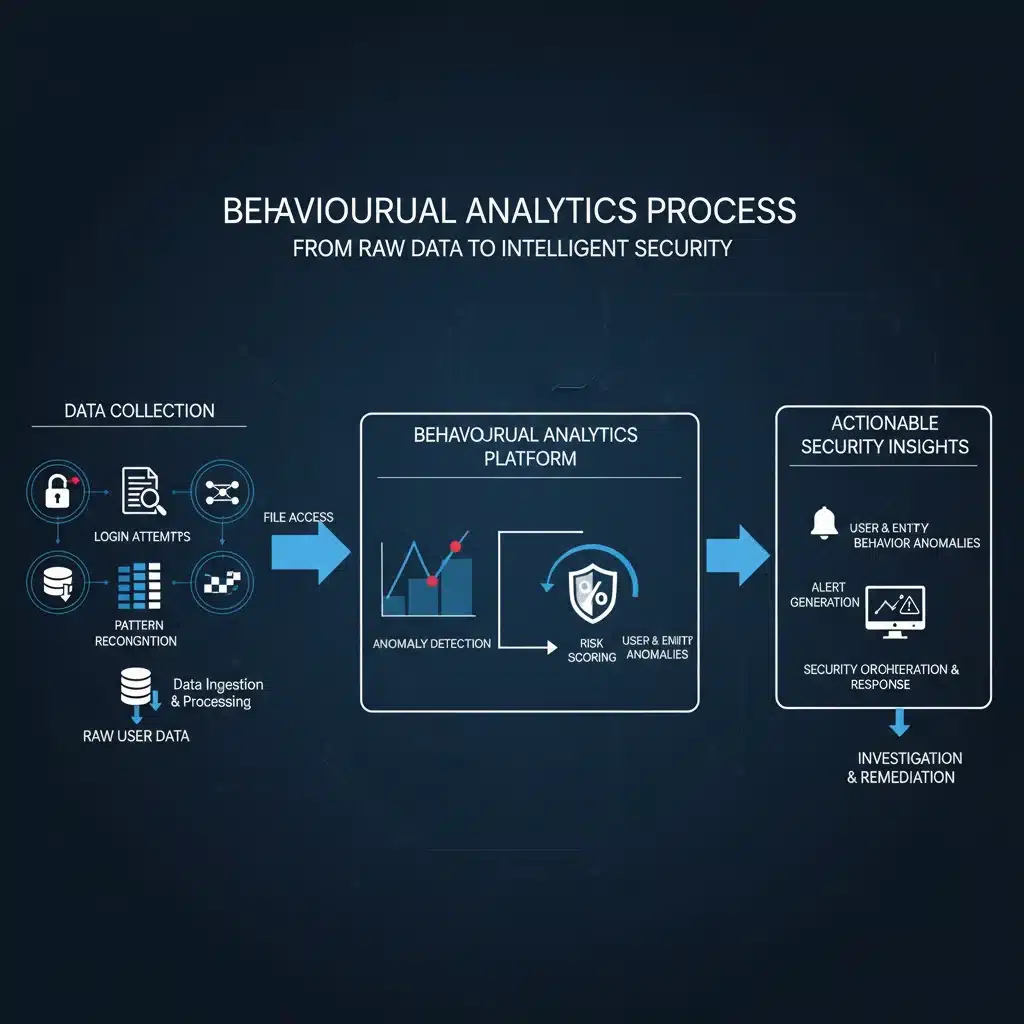
Insider Threat Behavioural Analytics (ITBA), often referred to as User and Entity Behaviour Analytics (UEBA), is a security solution that uses machine learning and artificial intelligence to monitor, analyse, and establish baseline patterns of normal user behaviour within an organisation’s network. By continuously comparing current activities against these baselines, ITBA can detect deviations that indicate potential insider threats.
Here’s how it works:
- Data Collection: ITBA solutions ingest vast amounts of data from various sources across the IT environment. This includes:
- Login attempts (successful/failed, time, location)
- Application usage (which apps, how often, what actions)
- File access and modification (what files, when, how much data)
- Email and communication patterns (unusual attachments, external recipients)
- Network activity (unusual traffic, access to restricted sites)
- Endpoint activity (USB device usage, software installations)
- Physical access logs (for integrated systems)
- Baseline Creation: Machine learning algorithms process this data to build a comprehensive profile of each user’s normal behaviour. This baseline is dynamic, adapting as user roles and responsibilities change over time. For example, a marketing executive’s normal data access patterns will differ significantly from a software developer’s.
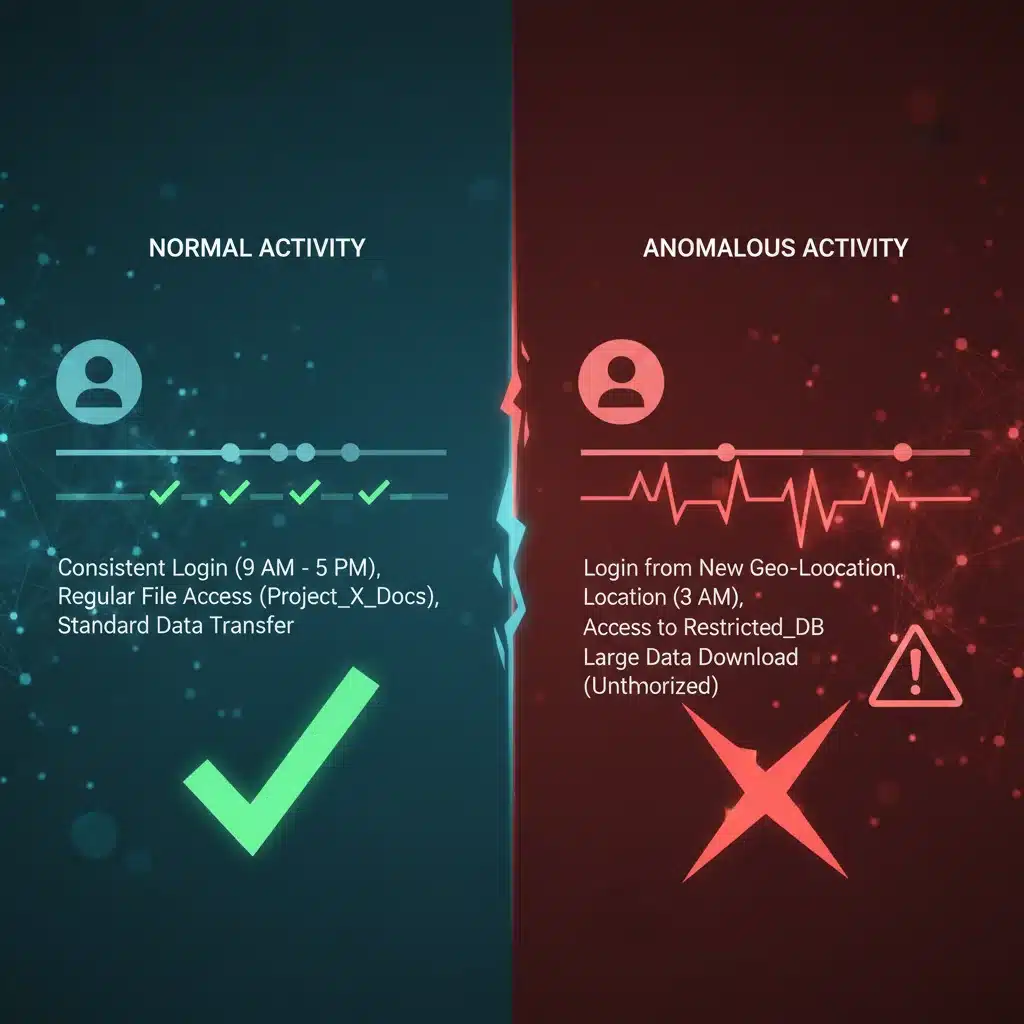
- Anomaly Detection: Once baselines are established, the system continuously monitors new activities for deviations. An anomaly could be:
- A user accessing a database they’ve never touched before.
- An employee logging in at an unusual hour or from an unfamiliar location.
- A sudden increase in data downloads or file transfers to external storage.
- Attempts to access highly sensitive information outside of normal work hours.
- Unusual email forwarding rules or attachments sent to personal accounts.
- Risk Scoring and Alerting: Instead of generating isolated alerts for each anomaly, ITBA systems typically assign a risk score to each user or entity based on the severity and frequency of detected deviations. This aggregated risk score helps security teams prioritise investigations, focusing on the most critical threats. High-risk activities trigger automated alerts to security personnel.
This proactive approach allows organisations to identify and mitigate insider threats before they escalate into full-blown breaches, making it a cornerstone of modern cybersecurity.
Meeting 2026 Compliance Requirements with Behavioural Analytics
As the regulatory landscape evolves, compliance mandates are becoming more stringent, demanding a higher level of visibility and control over internal operations. While specific 2026 regulations are still taking shape, the trend is clear: greater accountability for data protection, stricter requirements for breach notification, and an emphasis on proactive risk management. Insider Threat Behavioural Analytics directly addresses several key areas relevant to future compliance:
1. Enhanced Data Protection and Privacy
Regulations like GDPR, CCPA, and emerging global standards increasingly focus on protecting sensitive data. ITBA provides an auditable trail of who accessed what data, when, and from where. By detecting unusual data access or exfiltration attempts, it helps prevent breaches that could lead to hefty fines and reputational damage. This granular visibility is crucial for demonstrating due diligence in data protection.
2. Proactive Risk Management and Mitigation
Future compliance frameworks will likely demand a more proactive stance on security, moving beyond reactive incident response. ITBA’s ability to identify early warning signs of malicious or negligent insider activity allows organisations to intervene before data is compromised. This aligns with a preventative security model, which will be a hallmark of 2026 compliance.
3. Audit Trails and Forensic Capabilities
In the event of an incident, regulatory bodies require detailed accounts of what happened, how it was detected, and what steps were taken. ITBA systems provide rich, contextualised audit trails of user activities, which are invaluable for forensic investigations and demonstrating compliance post-breach. The data collected by ITBA can help reconstruct events, identify the root cause, and prove that appropriate controls were in place.
4. Demonstrating Security Control Effectiveness
Compliance often involves demonstrating that security controls are not just in place, but are also effective. By continuously monitoring user behaviour, ITBA provides objective evidence of security control effectiveness. It can highlight areas where controls might be weak or where employees are circumventing policies, allowing organisations to refine their security posture iteratively.
5. Addressing Supply Chain and Third-Party Risks
As organisations increasingly rely on third-party vendors and contractors, the insider threat extends beyond direct employees. ITBA can be extended to monitor the behaviour of third-party users with access to your systems, ensuring their activities align with contractual agreements and security policies. This is vital for managing supply chain risk, an area of growing regulatory focus.
Practical Solutions for Implementing Insider Threat Behavioural Analytics
Implementing Insider Threat Behavioural Analytics is a strategic undertaking that requires careful planning and execution. Here are practical steps and considerations for a successful deployment:
1. Define Your Objectives and Scope
Before selecting a solution, clearly define what you aim to achieve. Are you primarily concerned with data exfiltration, intellectual property theft, system sabotage, or compliance? Identify the high-value assets and critical systems that need protection. Start with a focused scope and expand incrementally.
2. Data Source Integration
A robust ITBA solution requires access to diverse data sources. Plan for integration with:
- Identity and Access Management (IAM) systems (Active Directory, Okta)
- Security Information and Event Management (SIEM) systems
- Endpoint Detection and Response (EDR) tools
- Data Loss Prevention (DLP) solutions
- Cloud access security brokers (CASBs)
- Network logs, firewall logs, and proxy logs
- HR systems (for user context like role changes, terminations)
The more data sources, the richer the behavioural profiles and the more accurate the anomaly detection.
3. Baseline Establishment and Calibration
Upon deployment, the ITBA system will enter a learning phase to establish baselines. This period is crucial. It’s important to:
- Allow Sufficient Time: Don’t expect immediate results. Machine learning models need time to observe and learn normal behaviour patterns.
- Initial Tuning: Work with your vendor to fine-tune the algorithms and reduce false positives. This might involve adjusting sensitivity levels or whitelisting known legitimate activities.
- Dynamic Baselines: Ensure the solution can adapt to changes in user roles, projects, and organisational structure. Static baselines quickly become irrelevant.
4. Policy and Rule Definition
While behavioural analytics excels at detecting unknown threats, it should also be complemented by defined policies and rules. For example, a rule might flag any attempt to access a specific highly confidential database by anyone outside a designated team, regardless of their behavioural baseline. This hybrid approach combines the strengths of rule-based detection with the adaptability of behavioural analytics.
5. Incident Response Playbooks
Detection is only half the battle. Develop clear and concise incident response playbooks specifically for insider threat scenarios. These playbooks should outline:
- Who is notified when a high-risk alert is triggered.
- Steps for investigating the anomaly (e.g., gathering more context, interviewing the user, reviewing logs).
- Actions to take if a threat is confirmed (e.g., revoking access, isolating systems, legal procedures).
- Communication protocols with HR, legal, and senior management.
6. User Training and Awareness
A significant portion of insider threats stems from negligence. Regular, engaging security awareness training can significantly reduce this risk. Educate employees on:
- The importance of data security and their role in it.
- Common social engineering tactics (phishing, pretexting).
- Proper handling of sensitive data.
- The consequences of security policy violations.
Transparency about the monitoring in place (without revealing specific detection methods) can also act as a deterrent.
7. Privacy Considerations and Legal Review
Monitoring employee behaviour raises privacy concerns. It’s imperative to:
- Communicate Clearly: Inform employees about the monitoring practices, the data collected, and the purpose (e.g., security, compliance) through clear policies and employee handbooks.
- Legal Counsel: Consult with legal counsel to ensure your ITBA implementation complies with all relevant privacy laws and employment regulations in your jurisdiction.
- Data Minimisation: Collect only the data necessary for security purposes.
- Role-Based Access: Restrict access to ITBA data and dashboards only to authorised security personnel.
Balancing security needs with employee privacy is critical for successful and ethical ITBA deployment.
8. Continuous Monitoring and Improvement
Cybersecurity is not a static state. Regularly review the effectiveness of your ITBA solution. Analyse alerts, false positives, and confirmed incidents to refine your baselines, policies, and response procedures. As your organisation evolves, so too should your insider threat programme.
Key Features to Look for in an Insider Threat Behavioural Analytics Solution
When evaluating ITBA solutions, consider the following essential features:
- Machine Learning and AI Capabilities: Advanced algorithms for accurate anomaly detection and dynamic baselining.
- Comprehensive Data Ingestion: Ability to integrate with a wide range of data sources across cloud, on-premises, and hybrid environments.
- Contextualisation: The ability to enrich raw data with user identity, role, department, and asset criticality for better risk assessment.
- Risk Scoring and Prioritisation: A clear, actionable risk scoring mechanism that helps security teams focus on the most critical threats.
- Visualisation and Reporting: Intuitive dashboards and reports that provide insights into user behaviour, anomalies, and overall risk posture.
- Forensic Capabilities: Detailed audit trails and the ability to quickly drill down into specific events for investigation.
- Integration with Existing Security Stack: Seamless integration with SIEM, SOAR, and other security tools for automated response workflows.
- Scalability: The ability to scale with your organisation’s growth and increasing data volumes.
- User Privacy Controls: Features that help anonymise data where appropriate and ensure compliance with privacy regulations.
The Future of Insider Threat Detection: Beyond 2026
As we look beyond 2026, Insider Threat Behavioural Analytics will continue to evolve. We can anticipate:
- More Sophisticated AI: Further advancements in AI and deep learning will lead to even more accurate detection, reduced false positives, and the ability to identify increasingly subtle behavioural shifts.
- Predictive Analytics: Moving beyond anomaly detection to predictive capabilities, where systems can forecast potential insider threats based on a combination of behavioural cues and external factors (e.g., financial distress, job dissatisfaction signals from HR data, if ethically integrated).
- Integration with Zero Trust Architectures: ITBA will become an integral component of Zero Trust frameworks, continuously verifying user and device trust based on behavioural context, rather than just static credentials.
- Human-Machine Teaming: Security analysts will increasingly work alongside AI-powered ITBA systems, leveraging the AI for pattern recognition and anomaly detection, and applying human intuition and contextual understanding for complex investigations.
- Focus on User Experience: Solutions will become more user-friendly, providing clearer insights and easier navigation for security teams.
The convergence of advanced analytics, robust data sources, and evolving regulatory pressures positions ITBA as a foundational pillar of future cybersecurity strategies.
Conclusion
The threat from within is a persistent and growing challenge for organisations worldwide. Traditional security measures, while essential, are often insufficient to combat the nuanced and context-rich nature of insider risks. Insider Threat Behavioural Analytics offers a powerful and proactive defence mechanism, leveraging the intelligence of machine learning to detect anomalous user behaviours that signal potential data breaches, sabotage, or intellectual property theft.
As organisations prepare for the stricter compliance mandates anticipated by 2026, implementing a comprehensive ITBA solution is not merely an option but a strategic imperative. It provides the necessary visibility, contextual intelligence, and proactive capabilities to protect critical assets, maintain regulatory adherence, and safeguard organisational reputation. By embracing practical solutions and fostering a culture of security awareness, businesses can effectively mitigate insider threats and build a resilient, future-proof security posture.
Investing in Insider Threat Behavioural Analytics today is an investment in the long-term security and compliance of your organisation. It empowers security teams to move beyond reactive incident response to proactive threat hunting, transforming the internal security landscape and ensuring peace of mind in an increasingly complex digital world.