Ransomware Tactics: 2024 vs. 2025 US Threat Landscape Analysis
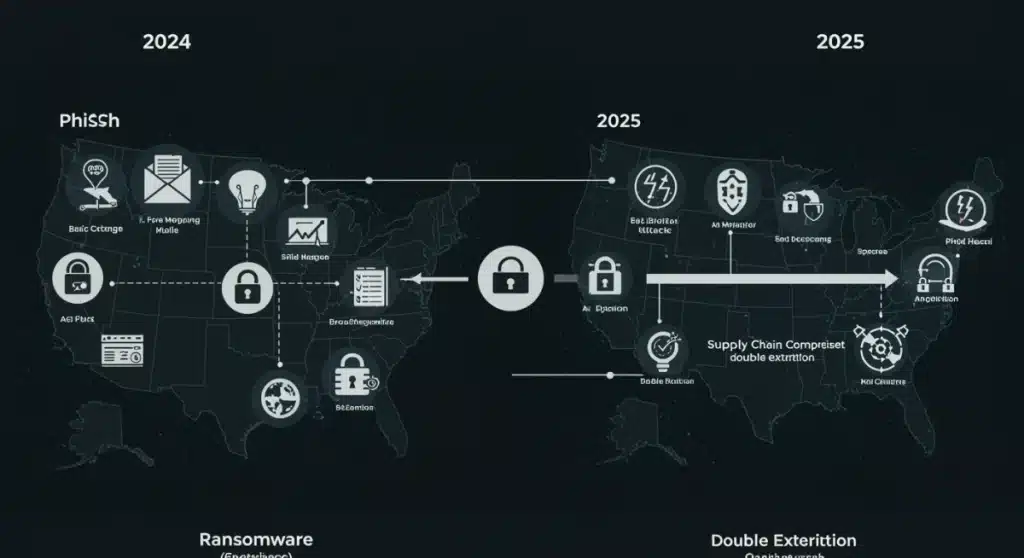
As the digital landscape continuously shifts, understanding the nuances of ransomware tactics US organisations face is critical. The evolution from 2024 to 2025 promises a more complex and perilous environment, demanding a proactive and adaptable cybersecurity posture from businesses and government agencies across the United States. This analysis delves into the emerging trends, comparing the threat landscapes of these two pivotal years.
The evolving nature of ransomware: 2024’s foundations
In 2024, ransomware remained a predominant cyber threat, characterised by its disruptive potential and financial motivations. Attackers primarily leveraged well-established techniques, albeit with increasing sophistication. The focus was often on exploiting known vulnerabilities and human error.
Organisations in 2024 primarily contended with ransomware variants that focused on encrypting data and demanding cryptocurrency payments. While data exfiltration for double extortion was common, the scale and automation of these operations were still maturing. Many attacks originated from financially motivated cybercriminal groups, often operating from regions with lax cybercrime enforcement.
Key attack vectors in 2024
The primary entry points for ransomware in 2024 were consistent across many sectors. Understanding these vectors is crucial for appreciating the shifts expected in 2025.
- Phishing and social engineering: Malicious emails and deceptive communications were highly effective in delivering initial payloads.
- Exploitation of RDP and VPN vulnerabilities: Poorly secured remote access protocols continued to be a significant gateway for attackers.
- Software vulnerabilities: Unpatched systems, particularly those with publicly disclosed critical vulnerabilities, were frequently targeted.
- Supply chain attacks (nascent): While emerging, supply chain compromise was not yet as pervasive or sophisticated as anticipated for 2025.
The cybersecurity community in 2024 focused heavily on patching, employee training, and robust backup strategies. While effective against many threats, these measures would prove insufficient as attackers began to innovate more rapidly.
Anticipated shifts in 2025: a more complex landscape
Looking ahead to 2025, the ransomware threat landscape in the US is projected to become significantly more complex and challenging. Attackers are expected to refine their tactics, embracing advanced technologies and expanding their target scope. This evolution will necessitate a corresponding shift in defence strategies.
The year 2025 will likely see a move beyond mere data encryption and exfiltration. Ransomware groups will increasingly integrate advanced artificial intelligence (AI) and machine learning (ML) capabilities into their operations, making attacks more autonomous and difficult to detect. The lines between cybercrime and state-sponsored activities are also expected to blur further.
Emerging attack methodologies
Several new methodologies are expected to gain prominence, demanding heightened vigilance from US organisations.
- AI-driven reconnaissance and evasion: AI will enable attackers to automate target identification, craft highly convincing phishing campaigns, and dynamically adapt their malware to bypass traditional security measures.
- Weaponisation of zero-day exploits: The market for zero-day vulnerabilities will grow, making it easier for ransomware groups to acquire and deploy exploits before patches are available.
- Deepfake and voice cloning for social engineering: Advanced social engineering attacks will leverage deepfake technology to impersonate executives or trusted individuals, increasing the success rate of initial compromise.
- Operational technology (OT) and critical infrastructure targeting: As OT environments become more interconnected, ransomware groups will increasingly target these systems for maximum disruption and leverage.
The increased sophistication will put immense pressure on incident response teams, requiring faster detection and remediation capabilities. The traditional defence perimeter will continue to dissolve, making a ‘zero-trust’ approach indispensable.
The impact of artificial intelligence on ransomware operations
Artificial intelligence is poised to be a game-changer in the 2025 ransomware landscape, transforming both the offence and defence. In 2024, AI’s role was largely experimental or limited to specific tasks like threat intelligence analysis. By 2025, its integration into ransomware operations will be far more pervasive and strategic.
Attackers will harness AI to automate various stages of their kill chain, from initial reconnaissance to post-exploitation activities. This automation will not only increase the speed of attacks but also allow for more scalable and precise targeting. The ability of AI to analyse vast amounts of data will enable ransomware groups to identify the most valuable targets and the most effective attack paths.
AI-powered offensive capabilities
The use of AI will grant ransomware operators significant advantages.
- Automated vulnerability scanning: AI algorithms can rapidly scan vast networks for exploitable weaknesses, identifying entry points that might be overlooked by human operators.
- Polymorphic malware generation: AI can create malware that constantly changes its code signature, making it incredibly difficult for signature-based detection systems to identify.
- Adaptive social engineering: AI-powered tools will generate highly personalised phishing emails and messages, mimicking human communication patterns to bypass filters and trick recipients.
- Enhanced lateral movement: AI can learn network topologies and identify optimal paths for lateral movement, helping ransomware spread quickly and silently within compromised environments.
Organisations must therefore invest in AI-driven defence mechanisms that can detect subtle anomalies and predict potential attack vectors, moving beyond reactive security measures. The battle against ransomware will increasingly become an AI-versus-AI engagement.
Supply chain vulnerabilities: a growing attack surface
While supply chain attacks were a concern in 2024, their prominence and sophistication are expected to surge dramatically in 2025. Ransomware groups will increasingly view third-party vendors and software providers as lucrative entry points into their ultimate targets. A compromise at one point in the supply chain can cascade, affecting numerous downstream organisations.
The interconnectedness of modern business ecosystems means that an organisation’s security posture is only as strong as its weakest link. Attackers are exploiting this interconnectedness, recognising that breaching a smaller, less secure vendor can grant access to larger, more fortified enterprises. This strategy maximises impact while potentially minimising the effort required for initial access.
Securing the extended enterprise
Addressing supply chain vulnerabilities requires a comprehensive approach.
- Vendor risk management: Rigorous assessment and continuous monitoring of third-party vendors’ security practices will be paramount.
- Software bill of materials (SBOMs): Mandating and utilising SBOMs will provide transparency into software components, helping identify potential vulnerabilities inherited from third-party libraries.
- Micro-segmentation: Isolating critical systems and data within the network can limit the lateral movement of ransomware even if an initial breach occurs via a supply chain vector.
- Contractual obligations: Establishing clear security requirements and incident response protocols with all suppliers will be crucial.
Organisations cannot simply secure their own perimeters; they must extend their security vigilance across their entire supply chain to mitigate the escalating risk of ransomware via these indirect vectors.
Nation-state involvement and geopolitical motivations
The distinction between financially motivated cybercriminals and state-sponsored actors will become increasingly blurred in 2025. While 2024 saw some overlap, 2025 is expected to witness more direct or indirect involvement of nation-states in ransomware operations, driven by geopolitical objectives, espionage, or economic disruption.
Nation-states may leverage ransomware as a tool for hybrid warfare, targeting critical infrastructure, government agencies, or key industries of rival nations. They may also provide safe havens or even direct support to cybercriminal groups whose activities align with their strategic interests. This adds another layer of complexity to attribution and response.
The geopolitical dimension of ransomware
The implications of nation-state involvement are significant.
- Increased sophistication and resources: State-sponsored groups often possess superior technical capabilities and funding, leading to more advanced and resilient ransomware strains.
- Targeting of critical infrastructure: Attacks may shift from purely financial gain to disrupting essential services, causing widespread societal impact and potentially real-world harm.
- Difficulty in attribution: Nation-states often employ sophisticated obfuscation techniques, making it challenging to definitively attribute attacks and formulate appropriate responses.
- Escalation of cyber warfare: Ransomware could become a more prominent instrument in international conflicts, leading to retaliatory attacks and a heightened state of cyber tension.
Defending against nation-state-backed ransomware requires close collaboration between government intelligence agencies, private sector cybersecurity firms, and international partners. A purely defensive posture may not be sufficient; proactive intelligence gathering and threat sharing will be vital.
Defensive strategies for the 2025 ransomware threat
Given the anticipated evolution of ransomware tactics US organisations will face in 2025, a robust and adaptive defence strategy is no longer optional but essential. The focus must shift from reactive measures to proactive, intelligence-driven cybersecurity. This involves a multi-layered approach that integrates technology, processes, and human factors.
Organisations must move beyond traditional perimeter defences and embrace a ‘assume breach’ mindset. This means designing security architectures that can contain and mitigate the impact of a breach, rather than solely focusing on preventing it. Continuous monitoring, threat hunting, and rapid incident response will be paramount.
Key defence pillars for 2025
Effective defence against 2025 ransomware threats will rely on several core principles.
- Zero-trust architecture: Implement zero-trust principles where no user or device is inherently trusted, requiring continuous verification for access to resources.
- Advanced endpoint detection and response (EDR): Deploy EDR solutions with AI/ML capabilities to detect and respond to sophisticated, evasive malware and anomalous behaviour.
- Immutable backups and disaster recovery: Ensure critical data is backed up to immutable storage, isolated from the network, and regularly tested for rapid recovery.
- Security awareness and training: Continuously educate employees on evolving social engineering tactics, including deepfakes and advanced phishing techniques.
- Threat intelligence sharing: Actively participate in threat intelligence-sharing initiatives to stay informed about emerging threats and attacker methodologies.
The cybersecurity landscape of 2025 demands a holistic and integrated defence strategy, one that is continuously updated to counter the ever-evolving and increasingly sophisticated ransomware threats.
| Key Aspect | Brief Description |
|---|---|
| AI Integration | Ransomware in 2025 will heavily leverage AI for reconnaissance, evasion, and automated attacks, a significant leap from 2024’s limited use. |
| Supply Chain Risk | Expected surge in sophisticated supply chain attacks in 2025, using vendor vulnerabilities as entry points, compared to emerging threats in 2024. |
| Nation-State Influence | Increased blurring of lines between cybercrime and nation-state activities in 2025, driven by geopolitical objectives, moving beyond primarily financial motives of 2024. |
| Defence Focus | Shift from reactive to proactive, AI-driven, and zero-trust defence strategies in 2025, evolving from 2024’s emphasis on patching and backups. |
Frequently asked questions about ransomware in the US
In 2025, AI is expected to automate ransomware attack stages, from target identification and highly convincing phishing campaigns to dynamic malware adaptation. This will make attacks faster, more scalable, and harder to detect, requiring AI-driven defence systems to counter. It represents a significant leap from 2024’s limited AI use.
While 2024 saw broad targeting, 2025 is expected to feature more precise targeting, leveraging AI for deeper reconnaissance. There will be an increased focus on critical infrastructure and operational technology (OT) environments, along with more sophisticated supply chain exploitation compared to the nascent stages observed in 2024.
Nation-state involvement in ransomware is projected to intensify in 2025, blurring lines with cybercrime. Ransomware may be used for geopolitical objectives, espionage, or economic disruption, rather than solely financial gain. This could lead to more sophisticated attacks on critical infrastructure and increased difficulty in attribution.
In 2025, critical defence strategies for US organisations will include implementing zero-trust architectures, deploying advanced AI-driven EDR solutions, ensuring immutable backups, and continuous security awareness training. Proactive threat intelligence sharing and robust vendor risk management for supply chain security will also be essential.
Yes, supply chain attacks are expected to become significantly more prevalent and sophisticated in 2025. Ransomware groups will increasingly target third-party vendors as indirect entry points to compromise larger organisations, exploiting the interconnectedness of modern business ecosystems. This represents a major escalation from 2024’s trends.
Conclusion
The comparison of ransomware tactics US organisations faced in 2024 with the anticipated landscape of 2025 reveals a clear and concerning trajectory towards more advanced, autonomous, and geopolitically influenced threats. The integration of AI, the exploitation of supply chains, and the increasing involvement of nation-states are poised to redefine the challenges of cybersecurity. Proactive, adaptive, and intelligence-driven defence strategies, including zero-trust architectures and AI-powered security solutions, will be indispensable for safeguarding digital assets and critical infrastructure across the United States. Remaining vigilant and continuously evolving security postures will be the key to resilience in a rapidly changing cyber world.