Supply Chain Attacks: Behavioural Analytics for US Enterprises by Q2 2025

Implementing behavioural analytics for early detection of supply chain attacks is now a critical imperative for US enterprises, demanding strategic action before Q2 2025 to safeguard national infrastructure and corporate assets against evolving cyber threats.
The landscape of cyber threats is continuously evolving, with supply chain attacks: implementing behavioural analytics for early detection in US enterprises by Q2 2025 emerging as a paramount concern. These sophisticated attacks exploit vulnerabilities within an organisation’s extended network, making traditional security measures often insufficient. Understanding and proactively addressing this threat is no longer optional but a strategic necessity for all US businesses.
The evolving threat of supply chain attacks
Supply chain attacks represent a critical and growing risk to US enterprises. These attacks leverage trusted relationships, compromising software, hardware, or services at any point in the supply chain to gain unauthorised access to an organisation’s systems. The ripple effect can be devastating, impacting numerous downstream customers and partners.
Historically, cybercriminals focused on direct attacks, but the complexity and interconnectedness of modern business ecosystems have created new avenues for exploitation. A single compromise within a vendor or third-party provider can grant attackers a backdoor into countless organisations, often remaining undetected for extended periods. This paradigm shift demands a more sophisticated and proactive defence strategy.
Understanding the attack vectors
- Software supply chain compromise: Injecting malicious code into legitimate software updates or releases.
- Hardware tampering: Modifying hardware components during manufacturing or transit.
- Third-party vendor exploitation: Compromising a vendor’s systems to access shared resources or data.
- Open-source software vulnerabilities: Exploiting known or unknown flaws in widely used open-source components.
The scale and potential impact of these attacks necessitate a fundamental re-evaluation of security postures. Organisations must move beyond perimeter defence and embrace solutions that can identify subtle, unusual patterns indicative of a deeper compromise. The urgency is amplified by the time-sensitive nature of these threats, requiring significant advancements by Q2 2025.
What is behavioural analytics and why it matters
Behavioural analytics involves collecting and analysing user, endpoint, and network data to identify patterns and deviations from established baselines. Unlike signature-based detection, which relies on known threat indicators, behavioural analytics can spot novel and sophisticated attacks that bypass traditional defences.
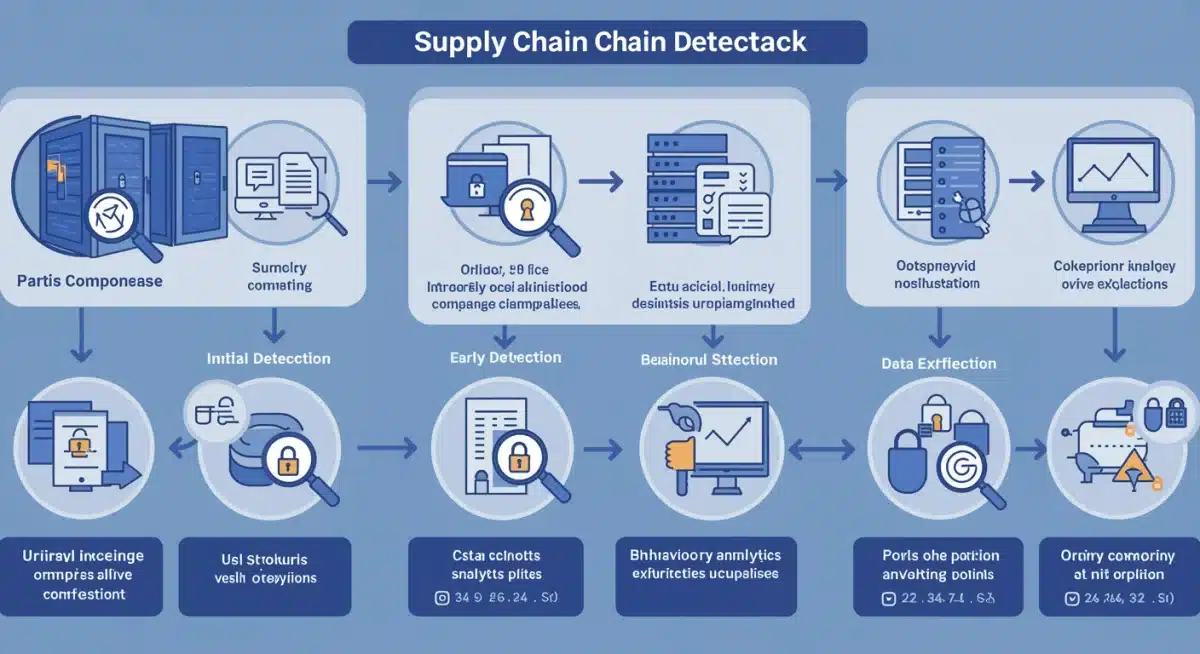
For supply chain security, this means monitoring the interactions between various entities within the extended network – from suppliers and partners to internal users and systems. Any anomalous activity, whether it’s an unusual login time, an unexpected data transfer, or a deviation in software build processes, can trigger an alert, indicating a potential compromise.
The intrinsic value lies in its ability to detect ‘unknown unknowns’ – threats for which no signatures yet exist. In the context of supply chain attacks, where adversaries often employ stealthy, persistent techniques, behavioural analytics provides an essential layer of defence by focusing on the ‘how’ rather than just the ‘what’ of an attack.
Implementing behavioural analytics by Q2 2025
The deadline of Q2 2025 for US enterprises to implement robust behavioural analytics capabilities is ambitious but critical. Achieving this requires a structured approach, starting with a comprehensive assessment of current security gaps and a clear roadmap for deployment.
Organisations must invest in the right technologies, but also in the talent and processes to effectively utilise these tools. This involves not only deploying sophisticated platforms but also training security teams to interpret the insights generated and respond decisively to emerging threats. Collaboration across departments, including IT, procurement, and legal, is also vital.
Key implementation steps
- Define scope and assets: Identify critical assets within the supply chain and relevant data sources for analysis.
- Establish baselines: Collect and analyse sufficient data to build accurate behavioural profiles for users, devices, and applications.
- Integrate with existing security infrastructure: Ensure seamless data flow and alert correlation with SIEM, SOAR, and other security tools.
- Develop incident response plans: Create specific protocols for responding to behavioural analytics-triggered alerts related to supply chain compromises.
Successful implementation by the Q2 2025 deadline will hinge on proactive planning, adequate resource allocation, and a commitment to continuous improvement. Enterprises that delay risk being left vulnerable to increasingly sophisticated and damaging supply chain attacks.
Challenges and considerations for US enterprises
While the benefits of behavioural analytics are clear, US enterprises face several challenges in its implementation. The sheer volume of data generated by modern IT environments can be overwhelming, requiring advanced processing capabilities and skilled analysts to extract meaningful insights. Additionally, the complexity of diverse supply chain ecosystems means that establishing accurate baselines can be a lengthy process.
Another significant hurdle is the potential for false positives. Overly sensitive behavioural models can flood security teams with alerts, leading to ‘alert fatigue’ and potentially obscuring genuine threats. Striking the right balance between sensitivity and accuracy is crucial for effective deployment and relies heavily on continuous tuning and refinement of the analytics engine.
Addressing common challenges
- Data privacy concerns: Ensuring compliance with data protection regulations while collecting and analysing behavioural data.
- Integration complexities: Harmonising new behavioural analytics platforms with existing, often disparate, security tools.
- Skill gap: Finding and retaining cybersecurity professionals with expertise in data science, behavioural analysis, and threat hunting.
- Budget constraints: Allocating sufficient financial resources for advanced analytics solutions and ongoing maintenance.
Overcoming these challenges requires a strategic, multi-faceted approach, combining technological investment with robust training programmes and a commitment to fostering a security-first culture across the organisation. Enterprises must view this not merely as an IT project, but as a fundamental shift in their overall risk management strategy.
Best practices for early detection
To maximise the effectiveness of behavioural analytics in detecting supply chain attacks, US enterprises should adhere to several best practices. Firstly, a ‘zero trust’ philosophy is paramount, assuming that no user, device, or application, whether internal or external, should be inherently trusted. This necessitates continuous verification of every access attempt and transaction.
Secondly, comprehensive visibility across the entire digital estate is crucial. This includes not only internal networks but also cloud environments, third-party applications, and supplier systems where possible. Without a holistic view, blind spots can remain, providing attackers with unmonitored pathways into the organisation.
Thirdly, continuous monitoring and threat hunting are essential. Behavioural analytics tools are powerful, but they are most effective when complemented by proactive human analysis. Security teams should actively hunt for anomalies and suspicious patterns rather than passively waiting for alerts.
Pillars of proactive defence
- Granular segmentation: Isolating critical systems and data to limit the lateral movement of attackers.
- Automated response capabilities: Implementing playbooks to automatically mitigate certain types of detected anomalies.
- Regular security audits and penetration testing: Validating the effectiveness of behavioural analytics and identifying new vulnerabilities.
- Vendor risk management: Integrating behavioural analytics into third-party risk assessments and continuous monitoring programmes.
By integrating these practices, organisations can transform their security posture from reactive to proactive, significantly enhancing their ability to detect and respond to supply chain threats before they escalate into major incidents.
The future of supply chain security beyond Q2 2025
While Q2 2025 marks a critical milestone for implementing behavioural analytics, the evolution of supply chain security will not cease there. The threat landscape is dynamic, and defence strategies must adapt continuously. Beyond this deadline, US enterprises will need to further refine their behavioural models, incorporating machine learning and artificial intelligence to predict potential attack vectors with even greater accuracy.
Future advancements will likely include deeper integration of threat intelligence feeds with behavioural analytics platforms, enabling context-rich detection and faster response times. The focus will also shift towards more sophisticated anomaly detection across increasingly complex multi-cloud and hybrid environments, as well as the burgeoning Internet of Things (IoT) landscape.
Furthermore, increased regulatory scrutiny and industry collaboration will play a pivotal role. Governments and industry bodies will likely mandate more stringent security requirements for supply chain participants, fostering a collective defence mechanism against systemic risks. The journey towards truly resilient supply chains is ongoing, with behavioural analytics forming a foundational component.
Enterprises must therefore view the Q2 2025 deadline not as a finish line, but as a crucial stepping stone in an enduring commitment to cybersecurity excellence. Continuous investment in technology, talent, and strategic partnerships will be key to staying ahead of the curve in a perpetually challenged digital world.
| Key Point | Brief Description |
|---|---|
| Urgency by Q2 2025 | US enterprises must implement behavioural analytics for supply chain attack detection by Q2 2025. |
| Evolving Threats | Supply chain attacks exploit trusted relationships, bypassing traditional security measures. |
| Detection Mechanism | Behavioural analytics identifies anomalous user, endpoint, and network patterns. |
| Strategic Implementation | Requires comprehensive assessment, technology investment, and skilled personnel. |
Frequently asked questions about supply chain security
Behavioural analytics is crucial because it can detect ‘unknown unknowns’ and subtle anomalies that signature-based systems miss. Supply chain attacks are often stealthy, making pattern-based detection essential for early identification and mitigation before widespread damage occurs.
US enterprises are urged to implement robust behavioural analytics capabilities for early detection of supply chain attacks by Q2 2025. This deadline highlights the urgent need for proactive measures against sophisticated and evolving cyber threats.
Key challenges include managing vast data volumes, establishing accurate baselines across complex supply chains, mitigating false positives, and addressing skill gaps in cybersecurity teams. Proper integration with existing infrastructure is also a significant hurdle.
Traditional security relies on known threat signatures, while behavioural analytics focuses on identifying deviations from normal behaviour. This allows it to detect novel attacks that have no existing signatures, providing a more adaptive and proactive defence against emerging threats.
Best practices include adopting a zero-trust philosophy, ensuring comprehensive visibility across the entire digital estate, conducting continuous monitoring and threat hunting, and integrating behavioural analytics with robust vendor risk management programmes for holistic security.
Conclusion
The imperative for US enterprises to implement behavioural analytics for early detection of supply chain attacks by Q2 2025 is clear and undeniable. The escalating sophistication of cyber threats demands a proactive and intelligent defence mechanism capable of identifying subtle anomalies before they escalate into catastrophic breaches. While challenges exist, the strategic investment in behavioural analytics, coupled with robust best practices and continuous adaptation, will be fundamental to safeguarding critical infrastructure and maintaining competitive advantage in an interconnected world. This is not merely a technological upgrade but a necessary evolution in cybersecurity posture, ensuring resilience against the threats of today and tomorrow.